


 Muhammad Saad

 Summarize in ChatGPT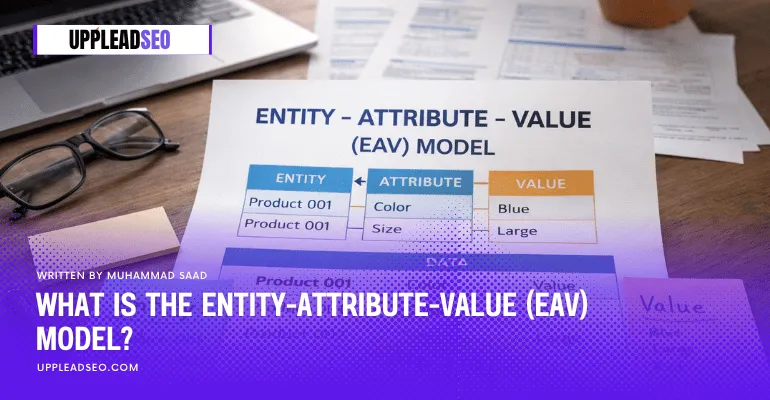
The entity-attribute-value (EAV) model is a sparse-data database pattern that stores each fact as one row made of an entity, an attribute, and a value. This Model Have 3 components, Entity, Attribute & Value. EAV is started with the concept of association lists. In Semantic seo, this is very important. You use EAV pairs in your sentence to increase your rankings. Rankings are increase because the cost of google to process your text is low.
What Is an Example of the EAV Model?
An example of the EAV model is OpenMRS storing a patient or encounter as the entity, a concept such as temperature as the attribute, and an observation such as 37.5 as the value. OpenMRS says the platform uses an EAV model for flexible clinical data storage without schema changes.
Illustrative EAV rows
| Row | Entity | Attribute | Value |
|---|---|---|---|
| 1 | SKU-1045 | brand | Lenovo |
| 2 | SKU-1045 | ram_gb | 16 |
| 3 | SKU-1045 | screen_inches | 14 |
| 4 | SKU-1045 | touchscreen | true |
| 5 | SKU-1045 | weight_kg | 1.39 |
Good attribute design uses 5 controls: attribute identifier, data type, allowed values, unit, and index priority. OpenMRS centers this on a concept dictionary, and OpenMRS guidance explains that the concept dictionary defines the terms used as questions and answers in observations.
What Are the Components of the EAV Model?
The EAV model has 3 core components: entity, attribute, and value. A clinical modeling paper describes the same triplet as the focus concept, the qualifier, and the valid value set.
| Component | Core job | Example |
|---|---|---|
| Entity | Identifies the record owner | Patient 2003 |
| Attribute | Names the property | body_temperature_c |
| Value | Stores the recorded content | 37.5 |
What Is the Entity?
The entity is the thing being described. In EAV pattern design, the entity is usually a patient, encounter, product, order, article, or business location, and the entity needs one stable identifier so all attribute rows point to the same record. OpenMRS gives patient or encounter as the entity example.
An entity can expand vertically without a schema rewrite. Illustratively, 1 product with 12 populated attributes becomes 12 stored facts, while 10,000 products with the same average become 120,000 fact rows.
What Is the Attribute?
The attribute is the named property or qualifier of the entity. In EAV data modeling, the attribute dictionary carries most of the semantic control because the attribute defines what the value means, how the value is typed, and how the value is validated. OpenMRS calls this control layer a concept dictionary.
Use the same design verb for every attribute rule:
- Define the data type.
- Define the unit.
- Define the controlled vocabulary.
- Define the validation rule.
- Define the index rule.
That discipline prevents duplicate attributes such as color, Colour, and product_color from describing the same fact.
What Is the Value?
The value is the actual recorded data for the attribute. The value can be text, number, boolean, date, or reference, and clinical EAV systems such as ACT/DB segregated data by type so values could be indexed when possible.
In Python, an analyst often reconstructs EAV rows into a dictionary or DataFrame before analytics. An illustrative record becomes {"brand": "Lenovo", "ram_gb": 16, "touchscreen": True}. The Python object is not the model itself; the Python object is a materialized view of the value layer.
What Is the History of the EAV Model?
The history of the EAV model is older than modern ecommerce and rooted in AI-style knowledge representation and clinical informatics. Biomedical abstracts trace EAV to LISP association lists, then clinical systems, then extensible scientific databases.
- Late 1970s: Clinical storage systems such as Duke’s TMR and the HELP system establish early medical use of EAV.
- March 1998: JAMIA documents ACT/DB as an attribute-value system for clinical trials data.
- September 2000: JAMIA publishes performance work comparing EAV and conventional schemas.
- Early 2000s: SenseLab uses EAV/CR for a neuroscience database in the Human Brain Project.
The historical pattern stays consistent: EAV appears when attributes are numerous, optional, and subject to change.
How Does the EAV Model Play a Role in Semantic SEO?
The EAV model plays a role in semantic SEO by forcing content teams to publish facts as entities, attributes, and explicit values instead of loose keyword repetition. Google says structured data gives explicit clues about page meaning, and Google uses that data to understand content and gather information about the web and the world.
Google’s Knowledge Graph made the same shift explicit in 2012. Google described the system as “things, not strings,” said the graph understood real-world entities and their relationships, and said the Knowledge Graph already contained more than 500 million objects and more than 3.5 billion facts and relationships.
Schema.org also mirrors EAV logic. Schema.org says PropertyValue is a property-value pair, additionalProperty represents an additional characteristic, and the project reports that, as of 2024, more than 45 million domains mark up pages with more than 450 billion Schema.org objects.
I describe SEO mapping in table:
| SEO layer | EAV lens | Example |
|---|---|---|
| Web page | Entity | “Dell XPS 13 review” |
| Section question | Attribute | battery life |
| First-sentence answer | Value | 12 hours tested |
| Schema markup | Structured attribute-value statement | batteryCapacity, weight, brand |
How Do We Increase Rankings Using the EAV Model in SEO?
To increase rankings using the EAV model, map one primary entity per page, publish the core attributes in visible copy, and mark the values with supported structured data. Google says structured data helps Search understand page content and can support richer search features, but Google also says rich-result display is not guaranteed and ranking systems use many page-level and site-wide signals.
Follow 6 execution steps:
- Define one primary entity for the URL.
- Standardize 8 to 15 core attributes for that entity type.
- Publish exact values in the first sentence, table, or list.
- Match visible text and structured data.
- Use specific schema properties instead of vague placeholders.
- Measure the page before and after implementation.
Google recommends JSON-LD when possible because it is easier to implement and maintain at scale. Google also says the markup must describe the visible page content, and Schema.org warns that generic PropertyValue usage does not usually create the same effect as a specific property when a specific property exists.
Google’s own structured-data case studies show why explicit values matter. Google reports 25% higher click-through rate for 100,000 Rotten Tomatoes pages enhanced with structured data, a 35% increase in visits at Food Network after 80% of pages enabled search features, 1.5x more time on page and 3.6x higher interaction at Rakuten, and 82% higher click-through rate for rich-result pages at Nestlé.
What Are Entity, Attribute, and Value in a Database?
In a database, entity, attribute, and value are the 3 parts of one stored fact. The entity owns the fact, the attribute names the property, and the value records the content. Clinical modeling literature describes the same pattern as focus concept, qualifier, and valid value set.
You can see bridge from database design to SEO execution in table:
| Database term | Database example | SEO equivalent |
|---|---|---|
| Entity | Local business profile | Primary page topic |
| Attribute | opening_hours | Section question |
| Value | Mon–Sat 08:00–18:00 | First-sentence answer |
| Entity | Product SKU | Product page |
| Attribute | battery_life_hours | Spec table row |
| Value | 14 | Exact factual value |
I think the main benefit is consistency. One attribute dictionary can drive copy, comparison tables, filters, FAQs, schema, and internal anchors across hundreds or thousands of pages.
What Is the Difference Between Entity-Attribute-Value and JSON?
Entity-attribute-value and JSON differ in where the facts live: EAV stores one fact per row, while JSON stores many facts inside one document. MySQL stores JSON in an internal format for quick read access and supports JSON functions, generated-column indexing, multi-valued indexes, and partial in-place updates; PostgreSQL provides jsonb, GIN indexing, and smaller, faster jsonb_path_ops indexes for supported operators.
| Dimension | EAV | JSON |
|---|---|---|
| Storage unit | One row per fact | One document per entity |
| Schema change | Add metadata and rows | Add keys to the document |
| Best strength | Shared sparse attributes across many entities | Nested payloads and API-friendly documents |
| Query pattern | Many joins or pivots for multi-attribute analysis | Path extraction inside one document |
| Indexing style | Composite relational indexes | JSON functions, generated columns, GIN/jsonb indexes |
| Analytics shape | Often pivots to wide tables | Often extracts or flattens keys |
| Best fit | Catalogs, medical observations, configurable metadata | Events, nested records, application payloads |
See Arithmetic
- 100,000 products with 200 possible attributes and 8 populated attributes each produce about 800,000 EAV fact rows.
- The same 100,000 products in JSON produce 100,000 documents.
- A fixed 200-column table implies 20,000,000 possible cells, with 96% empty in this scenario.
Choose EAV when the attribute catalog is shared, sparse, and governed across many entities. Choose JSON when a document boundary matters more than cross-entity attribute governance.
What Are the Criticisms of the EAV Model?
The main criticisms of the EAV model are query complexity, slower multi-attribute retrieval, weaker readability, higher governance cost, and poor fit for dense data. JAMIA abstracts say attribute-centric query is inherently more difficult in EAV than in conventional tables, and one performance study found attribute-centered EAV queries were approximately 3 to 5 times less efficient than conventional counterparts.
Researchers also identify 3 recurring operational costs. First, multi-attribute queries often need repeated self-joins. Second, dense data creates storage overhead because every stored fact repeats an object identifier and an attribute tag. Third, analytical workflows often pivot EAV into conventional relational form before warehousing, data mining, or machine learning.
A weak attribute dictionary makes the model worse. If one system records weight_kg, another records weight, and a third records mass, the database remains flexible but loses semantic precision.
Does Google Use an EAV Model?
Google uses entity-property reasoning, but Google has not publicly confirmed that Google Search runs on a classic relational EAV database. The careful conclusion is that Google clearly uses entity-based systems and structured-property extraction, while the exact storage architecture remains private.
The evidence for the conceptual overlap is strong. Google’s Knowledge Graph models entities and relationships at web scale, Google says structured data helps Search understand content and gather information about the web and the world, and Schema.org defines properties and property-value pairs as first-class web vocabulary. That is EAV-like logic, even if the back-end system is not publicly labeled “EAV.”