


 Muhammad Saad

 Summarize in ChatGPT
Silo SEO is a site architecture model that groups related pages under one parent topic and concentrates internal links within that group. A better option often exists: a flexible topic cluster with hub pages, support pages, and contextual cross-links aligns more closely with Google’s published guidance because Google uses links for discovery and relevance, ranks with many page-level signals, and generally infers site structure from page linkages rather than URL folders alone.
What Is Silo SEO?
Silo SEO is a topical site architecture that groups pages under one subject and routes internal links through that subject. In practice, the queries silo seo, seo silo, seo silo structure, silo structure seo, silo website, and silo site structure all point to the same operational goal: make related pages easier to crawl, interpret, and prioritize. Googlebot can find important pages by following internal links from the home page, and Google explicitly says comprehensive internal linking makes discovery easier.
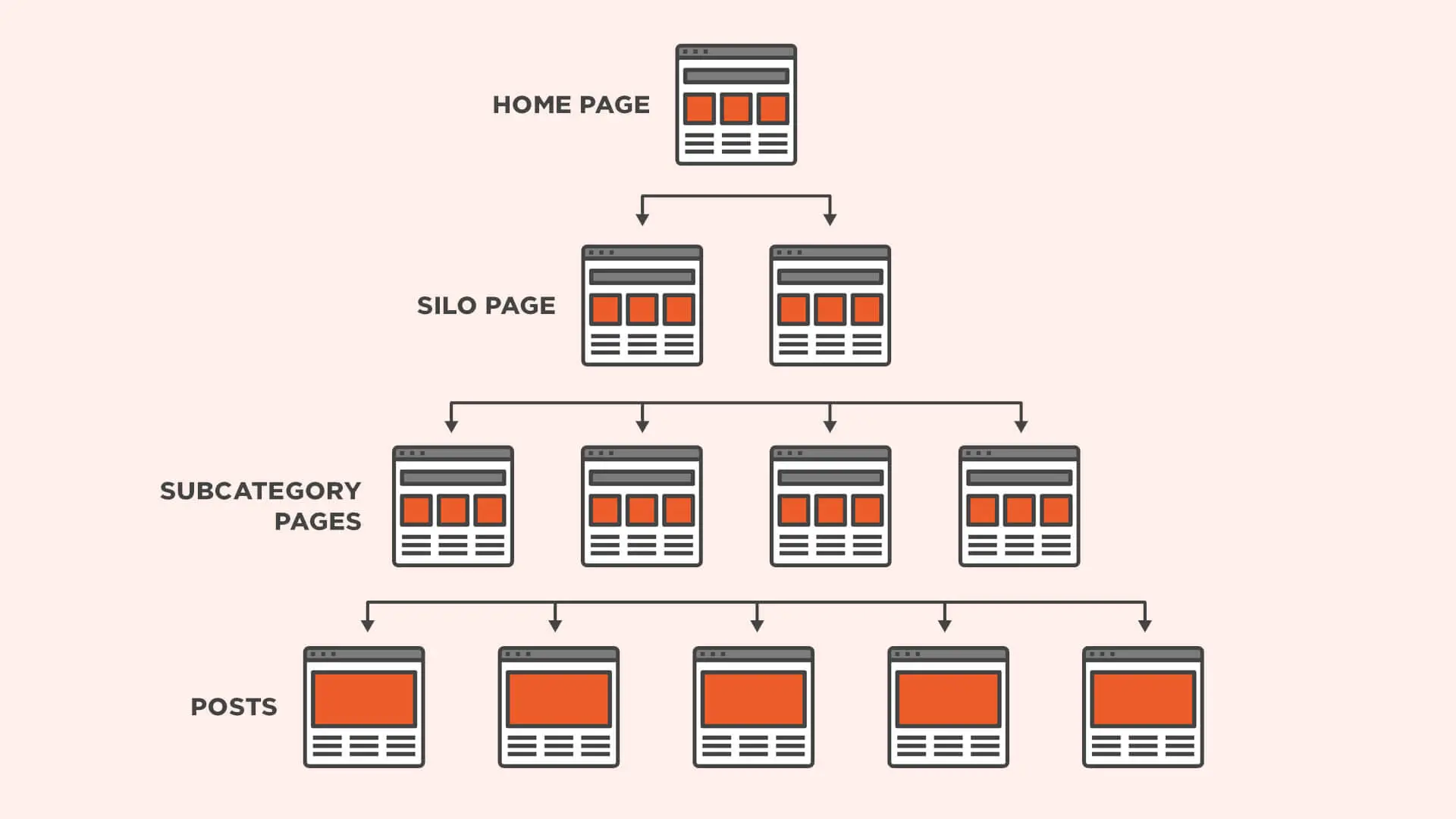
In digital marketing, a content silo is a bounded topic section. Siloing is the act of building that section. A silo is for 3 main jobs: clarifying navigation, concentrating internal link signals, and reducing topical ambiguity. Some teams describe the same pattern as silo marketing or website silo architecture.
The active signal is not the folder name. Google says it generally does not use URL structure to work out a site’s structure, and instead analyzes the relationship between pages based on linkages, link counts, and how many steps it takes to reach a page. A silo architecture helps only when the internal link graph is clear.
| Term | Meaning |
|---|---|
| Silo SEO | Group related pages under one topic and keep most internal links inside that topic |
| SEO silo structure | Use a hub page, supporting pages, and deliberate link flow |
| Content silo | Build a themed section around one subject, product class, or user problem |
| Siloing SEO | Organize existing pages into clearer topical groups |
| Silo website | Run most site sections as separate topical groups |
Does Silo SEO Really Build Topical Authority?
Silo SEO builds topical authority only when the silo contains comprehensive, original, and well-linked pages. Google says ranking systems work on the page level with many signals, site-wide signals only contribute to understanding, and helpful, reliable, people-first content with original information or analysis is what the systems try to prioritize. A tidy silo with thin pages does not become authoritative because the folder looks clean.
Stanford University’s Topic-Sensitive PageRank research generated 16 topic-sensitive PageRank vectors and showed that topic-biased link analysis can outperform a single generic PageRank. Google Research also summarizes two early web-search principles clearly: better pages tend to attract more links, and anchor text often describes a page well. That evidence supports internal links as a topical signal. That evidence does not prove that a hard directory silo creates authority by itself.
Topical authority grows fastest when 5 elements exist together:
- Complete coverage of the parent topic and its subquestions.
- Original information, analysis, or firsthand expertise.
- Relevant internal links between adjacent pages.
- Descriptive anchor text that matches destination intent.
- Clear entity relationships between the hub page and support pages.
Those 5 elements align with Google’s people-first content guidance, link best practices, and page-level ranking model.
Content Silos vs. Topic Clusters: What Is the Difference?
Content silos are restrictive sections with limited cross-links, while topic clusters are flexible hub-and-spoke systems that allow contextual cross-links between closely related subjects. Google’s documentation fits the cluster model better than the rigid silo model because Google recommends a logical site structure, links from relevant pages to important pages, and concise relevant anchor text, and Google says it infers structure from page linkages rather than URL folders.
A topic cluster usually matches mixed search behavior better. Queries such as silo seo, topical authority, internal linking in seo, anchor text, crawlability, and website silo architecture overlap at the document level. A rigid silo can block those natural relationships. Google’s guidance on page linkages and relevant internal links supports making those relationships explicit when the connection helps users.
The table below compares the two models by architecture, not by brand preference.
| Dimension | Content silo | Topic cluster |
|---|---|---|
| Primary organizer | Folder, section, or category boundary | Hub page plus related support pages |
| Cross-link policy | Often restricted to stay “inside” the silo | Allowed when pages are semantically adjacent |
| URL dependency | Often high | Usually low |
| Best user path | Linear | Contextual and multidirectional |
| Main strength | Order and governance | Query coverage and semantic flexibility |
| Main weakness | Over-isolation | Poor execution can create messy links |
What Is the Difference Between Soft and Hard Silos?
Hard silos are URL-, breadcrumb-, and navigation-based separations with limited cross-links, while soft silos are topic-led internal linking systems that can work even on flat URLs. Hard silos depend on directory rules. Soft silos depend on semantic internal links, hub pages, and contextual anchors. Because Google says it generally does not use URL structure alone to infer site structure, soft silos often capture most of the SEO value with less rigidity.
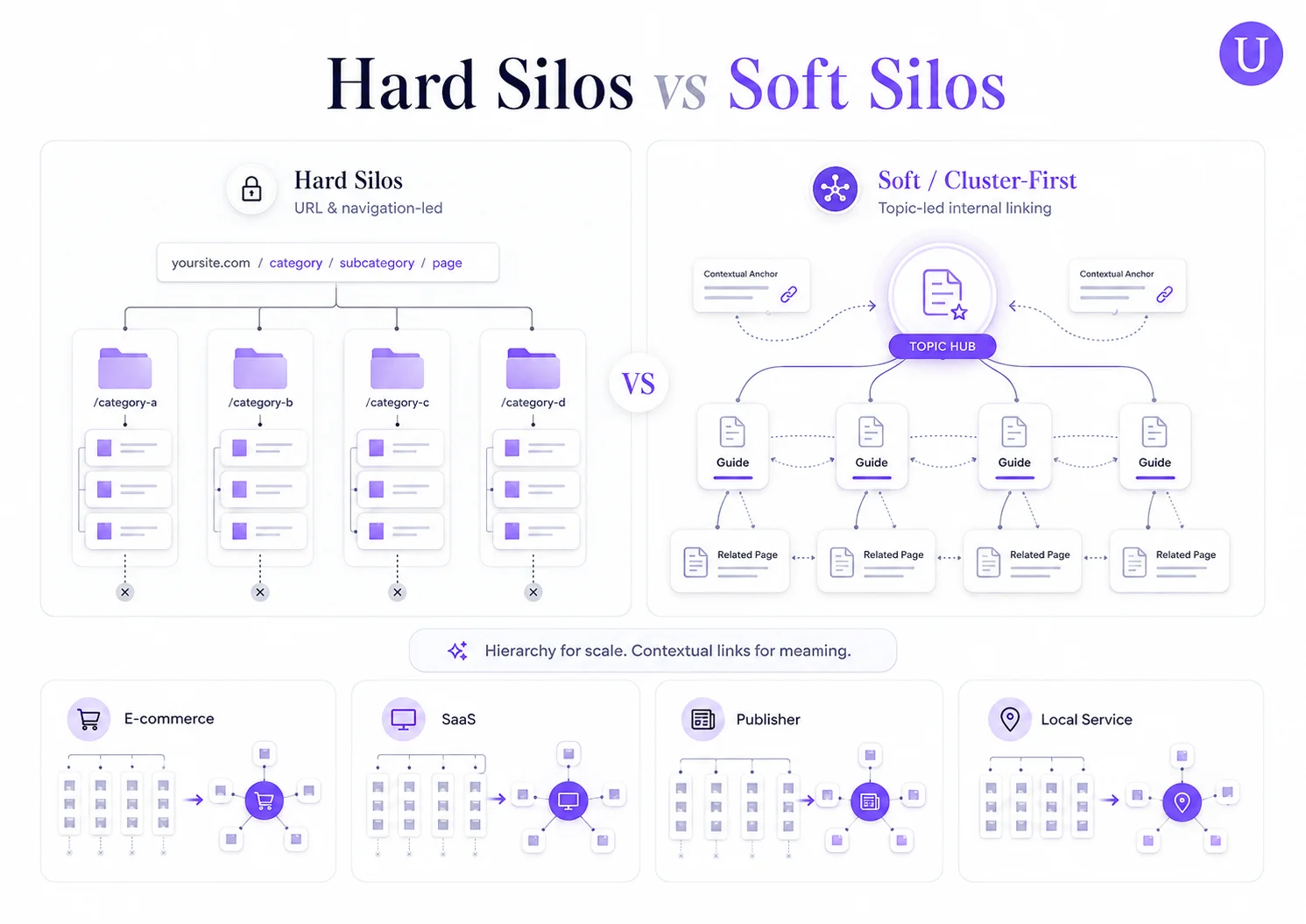
On very large sites, hierarchy still matters. In Google SEO Office Hours, Gary Illyes said a hierarchical structure is likely better for a large site because search engines may treat sections differently for crawling. The practical outcome is simple: use hierarchy for scale, and use contextual internal links for meaning.
The table below shows generic website examples with different silo architectures.
| Website type | Hard silo example | Cluster-first example |
|---|---|---|
| E-commerce | Running shoes section with only category and product links | Running shoes hub linked to fit guide, pronation guide, brand pages, and care guide |
| SaaS | CRM pages isolated from automation pages | CRM hub cross-linked with automation, integrations, onboarding, and pricing |
| Publisher | SEO section isolated from analytics and UX | SEO hub cross-linked with analytics, CTR, UX, and site architecture pages |
| Local service | Roofing city pages isolated by folder | Roofing hub linked with inspections, materials, insurance FAQ, permits, and city pages |
What Are the 5 Types of SEO Silos?
There are 5 common practitioner models of silo architecture. Google does not publish reverse silo, focused silo, or sequential silo as ranking-system names; Google’s published systems instead mention PageRank, BERT, Neural Matching, RankBrain, passage ranking, helpful-content-related core systems, and spam detection systems such as SpamBrain. The 5 types below are editorial link patterns, not Google algorithm labels.
| Silo type | Main link flow | Best use | Main risk |
|---|---|---|---|
| Reverse silo | Supporting pages link upward to a hub or primary commercial page | Service pages and conversion hubs | Over-optimized anchors |
| Top-down cycle silo | Hub links down; children link back and laterally | Categories, docs, knowledge bases | Deep pages stay weak if links are sparse |
| Interconnected silo | Related pages cross-link heavily within one topic | Complex informational topics | Link dilution from excess cross-links |
| Focused silo | Narrow section with few exits | Niche intent and clear commercial themes | Thin coverage |
| Sequential silo | Pages link in an ordered series | Tutorials, onboarding, step-by-step flows | End pages depend too much on prior steps |
What Is a Reverse Silo?
A reverse silo is a model where supporting pages push internal relevance and relative importance back to one parent hub or primary commercial page. A reverse silo works well when a site has one priority destination and several supporting articles answer narrower questions around that destination. Reverse silos work only when anchor text is descriptive, concise, and natural. Exact-match repetition across dozens of pages becomes keyword stuffing.
What Is a Top-Down Cycle Silo?
A top-down cycle silo is a hierarchy where the parent page links to child pages, each child links back to the parent page, and related child pages can link to the next relevant sibling. This model suits documentation, e-commerce categories, service libraries, and educational guides because it creates a predictable crawl path. Google’s guidance for large sites favors hierarchy for crawl management, and Google’s e-commerce documentation favors category-to-subcategory-to-detail navigation.
What Is an Interconnected Silo?
An interconnected silo is a topic group where related pages cross-link heavily inside the same subject area. This model fits complex subjects such as technical SEO, legal guidance, medical education, or B2B software because users often move between overlapping questions rather than a strict linear path. Interconnected silos map well to Google’s emphasis on page linkages and relevant internal links, but uncontrolled cross-linking can flatten page importance and blur the hub page.
What Is a Focused Silo?
A focused silo is a narrow topical section built around one entity, service, product category, or user problem. This model reduces semantic drift and helps one section keep a clean vocabulary, a clear intent pattern, and tight internal linking. The weakness is thinness: a focused silo with duplicate pages, shallow answers, or no original information conflicts with Google’s people-first and original-information guidance.
What Is a Sequential Silo?
A sequential silo is an ordered content chain that follows a process, curriculum, lifecycle, or funnel stage. Sequential silos work for tutorials, troubleshooting flows, onboarding sequences, and multi-step compliance content. Each step still needs normal internal links from other relevant pages because Google expects important pages to be discoverable through internal links, not only through “next step” navigation.
What Is the Problem with Content Silos?
The main problem with content silos is over-isolation. Googlebot discovers many pages through links, Google infers relative importance from page linkages, and Google recommends linking important pages from other relevant pages. When a hard silo blocks legitimate cross-links, the architecture starts serving the rule instead of the user.
Four problems appear most often:
- Over-isolated pages reduce topical context. A page about internal links often needs direct connections to anchor text, crawlability, site structure, and PageRank. Restrictive silos can hide those relationships.
- URL obsession misreads the signal. Google says it generally does not use URL structure to determine site structure; linkages matter more.
- Thin support pages create empty architecture. Google’s systems prioritize helpful, original, people-first content, not pages created mainly to manipulate rankings.
- Hard silos create orphan-page risk. Google advises that every important page should be reachable via internal links, and Google says a small site that is comprehensively linked internally may not even need a sitemap.
What Is the Argument for SEO Silo Structure?
The argument for SEO silo structure is clarity. A good silo makes crawl paths shorter, hub pages more visible, anchor text more consistent, and section governance easier. Google’s own documentation supports those benefits: hierarchical structures can help large sites, logical site structure helps sitelinks, and comprehensive internal linking helps Googlebot find important pages.
A silo structure is strongest in 4 conditions:
- Large catalogs with stable categories.
- Documentation libraries with clear parent-child relationships.
- Multi-location or multi-service sites with repeated templates.
- Sites that need stronger editorial governance across many authors.
What Are the Best Practices for Internal Linking in SEO?
The best internal-linking practice is to connect every important page with crawlable, contextual, and descriptive links from relevant pages. Google’s guidance is direct on 4 points: use crawlable links, use descriptive anchor text, create a logical structure, and link important pages from relevant pages.
- Use crawlable HTML links. Google can reliably crawl standard
<a href>links. Many non-anchor or JavaScript-triggered links are less dependable for discovery. - Link every important page from at least one other page. Google says every page that matters should have internal links, and proper linking means important pages are reachable through navigation or page links.
- Write anchors that are descriptive, concise, and relevant. Google says strong anchor text helps people navigate and helps Google understand the destination page.
- Avoid generic anchors and keyword stuffing. “Click here” is weak, and forced exact-match anchors can cross into spam territory.
- Link important pages from relevant pages. Relevance of source context matters because Google explicitly recommends links from relevant pages to important pages.
- Build full paths from hub to detail pages. Google’s e-commerce documentation recommends links from menus to categories, categories to subcategories, and subcategories to products. Googlebot generally does not search a site’s internal search box during crawling.
- Use sitemaps as reinforcement, not replacement. Google says small sites of about 500 pages or fewer may not need a sitemap if they are comprehensively linked internally, but large or complex sites often benefit from one.
If Silo SEO Is Not the Best Option, What Is the Better Option?
The better option is a topical hub-and-cluster model that’s called topical map in semantic seo with contextual internal links and flexible cross-links between adjacent pages. This model matches Google’s published behavior better because Google interprets site structure through page linkages, ranks with many page-level signals, and prioritizes helpful, reliable, original content.
A practical cluster model has 4 parts:
- One hub page for the head topic.
- Several support pages for subquestions and subentities.
- Two-way links between the hub and support pages.
- Contextual cross-links between support pages when user intent overlaps.
Example architecture for a technical SEO section:
- Hub: internal linking in SEO
- Support page: silo SEO
- Support page: topic clusters
- Support page: anchor text
- Support page: crawlability
- Support page: page authority distribution