


 Muhammad Saad

 Summarize in ChatGPT
On-page SEO is the page-level system of content, HTML signals, media, internal links, structured data, and UX. URL edits still matter when they improve crawl clarity and canonical consistency. Titles still matter because Google builds title links from titles, headings, and anchor text.
Meta descriptions are just working in some area for telling search engines that this is what article about That’s it. it’s not now ranking factors or affect rankings. keyword stuffing is spam and Google does not use the meta keywords tag. AI search did not replace SEO fundamentals; Same SEO basics remain relevant for AI features. The dark truth is that a checklist creates eligibility and cleanliness, but rankings come from better information, clearer structure, and stronger relative value than competing pages.
What is On-page SEO?
On-page SEO is the page-level practice of improving meaning, crawl clarity, click appeal, and usability inside a webpage and its HTML. Google’s documentation describes SEO as helping search engines understand content and helping users decide whether to visit, while Google’s ranking guide says ranking works on the page level with some site-wide signals layered on top.
On-page SEO is not one field. On-page SEO is 3 connected layers. The first layer is document meaning: headings, body copy, tables, FAQs, media context, and entity coverage. The second layer is document packaging: title, snippet, URL, canonicals, and structured data. The third layer is document usability: speed, layout stability, mobile display, and clear main-content presentation. Google treats these as complementary, not isolated tricks.
What Comes Under On-Page SEO?
There are 7 main on-page SEO layers: URL structure, title and snippet surfaces, content and heading structure, image and media optimization, internal linking, structured data, and page experience. The table below condenses current Google documentation into one practical 2026 framework.
| On-page layer | What belongs here | What Google or platform docs confirm | 2026 truth |
|---|---|---|---|
| URL structure | readable paths, canonicals, parameters, redirects | descriptive URLs help users and crawling clarity | URL work is an enablement lever, not a magic ranking lever |
| Title and snippet | title element, H1, meta description, preview controls | title links are auto-generated from several sources; snippets are mainly page-content driven | better SERP packaging improves CTR more than raw rankings |
| Main content | intro, headings, body copy, tables, FAQs, proof | helpful content favors original information, research, analysis, completeness | content depth beats checklist repetition |
| Images and media | alt text, filenames, captions, compression, video markup | alt text is the most important image metadata field; video uses separate markup | EXIF myths are weak; context and clarity win |
| Internal links | menus, contextual links, anchor text, click depth | links help discovery and relative importance | internal links remain one of the strongest controllable levers |
| Structured data | JSON-LD for article, organization, product, local business, video | structured data gives explicit clues and rich-result eligibility | schema helps understanding, not guaranteed rankings |
| Page experience | LCP, INP, CLS, mobile, HTTPS, intrusive UI | page experience matters, but there is no single page-experience signal | UX supports competitiveness when relevance is similar |
Does URL Optimization still work in 2026?
URL optimization still works when a URL becomes clearer, short, more canonical, and easier to crawl. Google recommends descriptive URLs, readable words instead of long IDs, and warns against using fragments to change page content. Google also treats canonical hints as hints, not rules.
A strong 2026 URL does 4 jobs. First, a strong URL states the topic in human language. Second, a strong URL avoids duplicate variants. Third, a strong URL stays persistent instead of changing with temporary parameters. Fourth, a strong URL stays consistent across internal links, sitemaps, and canonical tags. Ecommerce guidance from Google adds one more rule: use distinct URLs for meaningful variants, especially when product attributes change what the user buys.
Does optimizing the title still matter?
Optimizing the title still matters because the title link is still one of the main click and understanding surfaces in Search. Google says title links are generated automatically from multiple sources, including the <title> element, the visible main title, heading elements such as H1, anchor text on the page, and links pointing to the page.
A good 2026 title has 3 traits. A good 2026 title is unique to the page. A good 2026 title is clear and concise. A good 2026 title accurately describes what the page offers. Title optimization still matters, but “perfect title control” is gone because Google may rewrite the title link when another on-page or off-page source better represents the document.
Does Meta Description work in the AI era?
No, Meta description not work in this or ai era. but it helps google bot to understand more about your webpage and Google says snippets are primarily created from page content, but Google may use the meta description when the tag better describes the page than the visible text. Google also says pages appearing in AI features must first be eligible to show in Google Search with a snippet.
Does Image Metadata matter? What is the truth?
Image metadata matters, but image metadata matters mainly through alt text, filenames, page context, creator data, licensing data, and C2PA details, not through old EXIF-stuffing myths. Google says alt text is the most important attribute for image metadata, filenames provide light clues, captions and surrounding text influence image understanding, and IPTC or C2PA metadata can expose creator, licensing, or “About this image” details. The truth about image originality is narrower than many SEO checklists claim.
Google documents sharp, high-quality, relevant images near relevant text. Google also documents metadata for creator and usage information. Google does not document a guaranteed ranking bonus for stuffing camera metadata or forcing originality claims into file fields. In practice, original visuals help differentiation, trust, and click appeal, but the confirmed machine-readable signals are context, alt text, filenames, structured data, and crawlable access.
Should video information be written into image metadata?
Video information should not be written into image metadata because video SEO uses its own markup and indexing signals. Google’s video documentation uses VideoObject, thumbnail URLs, upload date, duration, key moments, and watch-page context, while image metadata documentation focuses on creator, licensing, and C2PA details.
Do keywords still matter, or is “keyword SEO” outdated?
Keywords still matter as query vocabulary and topical language, but keyword stuffing is outdated and the meta keywords tag is ignored. Google’s starter guide says to anticipate how users search, while also saying language matching can connect a page to related queries even when the page does not use every exact variation. Google’s spam policies explicitly define keyword stuffing as manipulative repetition.
The 2026 keyword model has 4 rules. Use the main phrase in the title, H1, and intro. Use close variants where the context changes. Use entity terms, attributes, and qualifiers in tables and sections. Stop repeating phrases once meaning is established. The modern goal is query coverage, not density inflation.
What does “helpful content” really mean?
Helpful content means original, complete, reliable content created to benefit people before rankings. Google’s people-first documentation asks whether content adds original information, reporting, research, or analysis, whether the page is substantial and complete, and whether the page demonstrates first-hand expertise and depth of knowledge. Google also notes that the former “helpful content system” is now part of the core ranking systems.
Helpful content is measurable on a page. Helpful content gives direct answers. Helpful content adds proof. Helpful content resolves the next question without forcing another click. Helpful content states limits and exceptions. Helpful content removes recycled filler. That is why fact-backed pages still outperform “SEO pages” that only reorder obvious information.
What is the best strategy of internal links?
The best internal linking strategy is to connect broad pages, supporting pages, and money pages with crawlable links and descriptive anchors. In internal linking 3 concepts are used root, seed and node. Root is main pillar like page it connects with the seeds and every seed have their own node and they connect with it. Google says links help discover pages, understand linked pages, and infer relative importance. Google’s ecommerce structure documentation also says linkages, click depth, and the number of links to a page can influence Google’s understanding of importance.
I give you example in image of root, seed, and node.
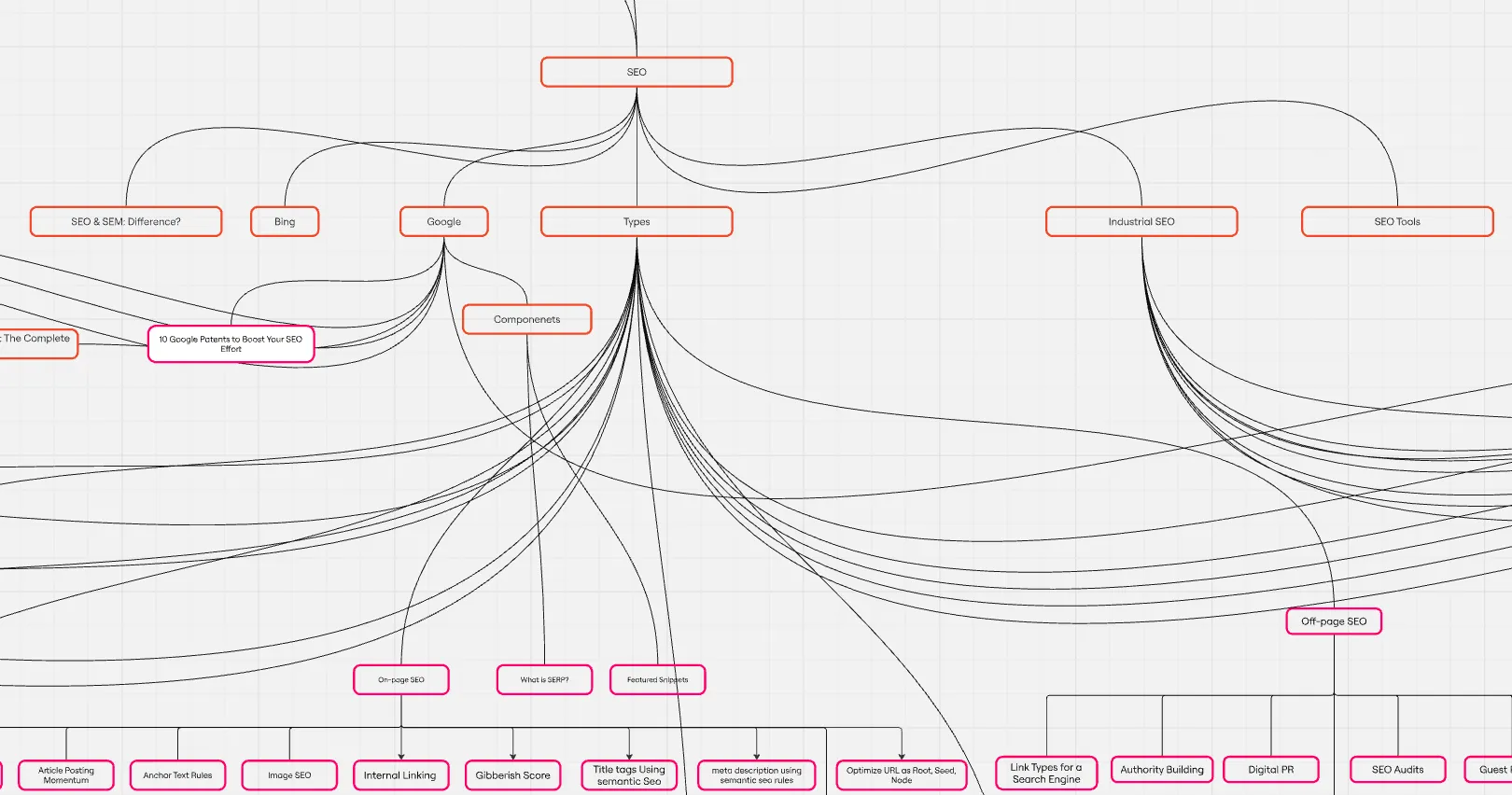
Here Root is SEO, Seed is Types(types of seo) and node is On-Page SEO.
Use this 5-step internal-link pattern:
- Link hub pages to every essential subtopic page.
- Link subtopic pages back to the main commercial or definitional page.
- Link high-authority pages to high-value pages.
- Link with descriptive anchor text, not generic text.
- Link with real
<a href>HTML elements, not JavaScript-only navigation.
That pattern works because important pages become easier to find, easier to crawl, and easier to classify inside the site graph. A “quality node” usually deserves more internal links than a thin support page.
How does Schema JSON-LD contribute to the Knowledge Graph?
JSON-LD contributes by giving Google explicit clues about entities, properties, and relationships, not by guaranteeing a Knowledge Panel or rich result. Google says structured data helps Search understand page content and gather information about the web and the world in general. Google also recommends JSON-LD because it is easier to implement and maintain at scale.
Schema also has measured upside in Google’s own case-study examples. Google cites Rotten Tomatoes reporting a 25% higher click-through rate on 100,000 pages with structured data, Food Network reporting a 35% increase in visits after enabling search features on 80% of pages, Rakuten reporting 1.5x more time on page and 3.6x higher interaction on AMP pages with search features, and Nestlé reporting an 82% higher click-through rate for rich-result pages. Those numbers do not prove “schema equals ranking,” but those numbers do prove that better machine-readable packaging can improve how users interact with eligible results.
Use JSON-LD in 2026 for 4 main entity jobs: Article for editorial pages, Organization for brand identity, LocalBusiness for service locations, and Product or ProductGroup for ecommerce pages. Keep one rule above all others: the structured data must match the visible page content, and correct markup still does not guarantee appearance in Search features.
What practices does Google prefer when choosing featured snippets?
Google does not provide a method to mark a page as a featured snippet. Google says featured snippets are chosen automatically by Google systems. Google also says pages can opt out with nosnippet, or reduce the chance of appearing by lowering max-snippet, and Google sends users directly to the relevant page section when systems can confidently identify the right location.
The practical featured-snippet pattern is a reasoned inference from Google’s snippet and featured-snippet documentation. Put a direct answer in the first sentence under the heading. Expand with a short list, table, or comparison. Keep the answer in snippet-eligible text. Avoid blocking previews with restrictive snippet controls. That pattern makes extraction easier because the answer exists in one clean semantic block.
What hierarchical structure works best: H1, H2, H3, and H4?
A clear hierarchy works best because hierarchy improves scanning, section meaning, and content navigation. Google’s starter guide recommends breaking long content into paragraphs and sections with headings. Google’s documentation style guide also recommends a unique H1 and warns against skipping heading levels. Google’s title-link documentation confirms that heading elements can also influence title-link generation.
A practical hierarchy uses 4 levels:
- H1 for the full document topic
- H2 for major intent blocks
- H3 for sub-questions inside the block
- H4 for exceptions, myths, or technical nuances
This hierarchy is not a direct ranking factor by itself. This hierarchy is a comprehension system. A cleaner comprehension system usually creates better extraction, better scrolling behavior, and better snippet candidates.
How does On-site UI Optimization affect SEO?
On-site UI optimization affects SEO through page experience, interaction quality, readability, and speed. Google says core ranking systems reward content that provides a good page experience, Core Web Vitals are used in ranking systems, and site owners should also care about secure delivery, mobile display, main-content clarity, intrusive interstitials, and ad distraction. Google’s image documentation adds that images are often the largest contributor to page size.
Google’s current “good” Core Web Vitals thresholds remain LCP at 2.5 seconds or less, INP at 200 milliseconds or less, and CLS at 0.1 or less, measured at the 75th percentile. The thresholds were set using HCI research, including work summarized around Card and Miller, and checked against Chrome User Experience Report data for achievability.
The UI rule is simple. Compress and resize images. Preserve layout stability. Reduce intrusive elements. Keep the main content visually dominant. These actions are not cosmetic. These actions affect interaction, bounce friction, scroll depth, and comparative competitiveness in crowded SERPs.
Which On-page factors influence AI content choices?
The main on-page factors influencing AI-content selection are the same core SEO factors that influence Search eligibility and document understanding. Google’s AI-features documentation says no special AI files, AI text files, or special schema are required. Google also lists internal links, page experience, textual availability of important content, high-quality images and videos, and structured data that matches visible text as worthwhile fundamentals for AI features. Supporting links in AI features must first be indexed and eligible to appear with a snippet in Google Search.
That means AI visibility is still page engineering. A page with weak text, weak internal discovery, mismatched schema, blocked crawling, or poor snippet eligibility is less usable for AI-assisted search surfaces. Google also says clicks from AI Overviews have been higher quality in the sense that users tend to spend more time on the site.
How do you fill content gaps?
You fill content gaps by finding missing intents, missing entities, missing proof, and missing internal paths. Search Console’s Performance report shows queries, pages, clicks, impressions, and CTR. Google’s site-structure guidance also shows that clearer internal paths help discovery and relative importance.
Use this 5-step gap method:
- Export Search Console queries for the page.
- Group queries by intent, modifier, and entity.
- Add missing sections, definitions, tables, and examples.
- Add internal links from the strongest relevant pages.
- Refresh data, screenshots, schema, and snippet blocks.
A true content gap is rarely “more words.” A true content gap is usually one missing answer block, one missing comparison, one missing evidence set, or one missing internal route.
How are semantics part of on-page SEO?
Semantics are the meaning layer of on-page SEO. Semantics matter because Google does not only match literal strings; Google also tries to understand how a page relates to many queries and many entities. Google says language-matching systems can relate a page to many queries, structured data provides explicit clues about meaning, and image understanding uses alt text, computer vision, and page context together.
In practical SEO writing, semantics means using the right entity, the right attribute, and the right modifier in the right section. A service page for “emergency dentist” needs symptoms, timing, location, phone, treatment scope, and urgent-intent language. A comparison page needs dimensions, trade-offs, and decision criteria. A product page needs brand, model, material, size, price, availability, and variant logic. Clear semantics create clean machine understanding.
Why should you understand micro and macro semantics?
Macro semantics is the page-wide topical flow from H1 to the last heading. Micro semantics is the sentence-level precision of entity, attribute, and action. “Micro semantics” is a practical content-engineering label, not a formal Google ranking-system term. The useful principle is that Google rewards content that is easier to parse, easier to align with queries, and easier to trust.
Macro semantics answers: does every section stay inside one topic graph? Micro semantics answers: does each sentence say exactly what the entity is, what the property is, and what the user learns? Pages lose precision when headings drift, pronouns hide the main entity, or sections repeat vague filler. Pages gain precision when headings, tables, images, and internal links all reinforce the same topic vector.
What is the difference between On-page SEO and Off-page SEO?
On-page SEO changes the page itself. Off-page SEO changes the page’s external discovery and reputation environment. Google’s starter guide treats other websites linking to a page as a natural discovery path, while Google’s spam policies also set boundaries for manipulative link behavior.
| SEO layer | Main focus | Typical assets | Main risk when weak |
|---|---|---|---|
| On-page SEO | meaning, packaging, usability | titles, body copy, schema, images, internal links, UX | page is unclear, thin, unconvincing, or unextractable |
| Off-page SEO | reputation, mentions, external references | backlinks, digital PR, reviews, citations, brand mentions | page is isolated, low-trust, or undiscovered |
| Technical SEO | eligibility and delivery | crawlability, canonicals, robots, sitemaps, rendering, redirects | page is broken, hidden, duplicated, or misindexed |
The cleanest way to think about the difference is simple. On-page SEO answers, “Is this page the right answer?” Off-page SEO answers, “Does the web trust or discover this page?” Technical SEO answers, “Can search systems access and process this page?”
What is the difference between On-page SEO and Technical SEO?
On-page SEO improves meaning, completeness, and click appeal. Technical SEO improves crawlability, rendering, indexing, canonicalization, and search eligibility. Google’s own guides separate title links, snippets, images, and structured data from canonicalization, robots, JavaScript SEO, and URL structure.
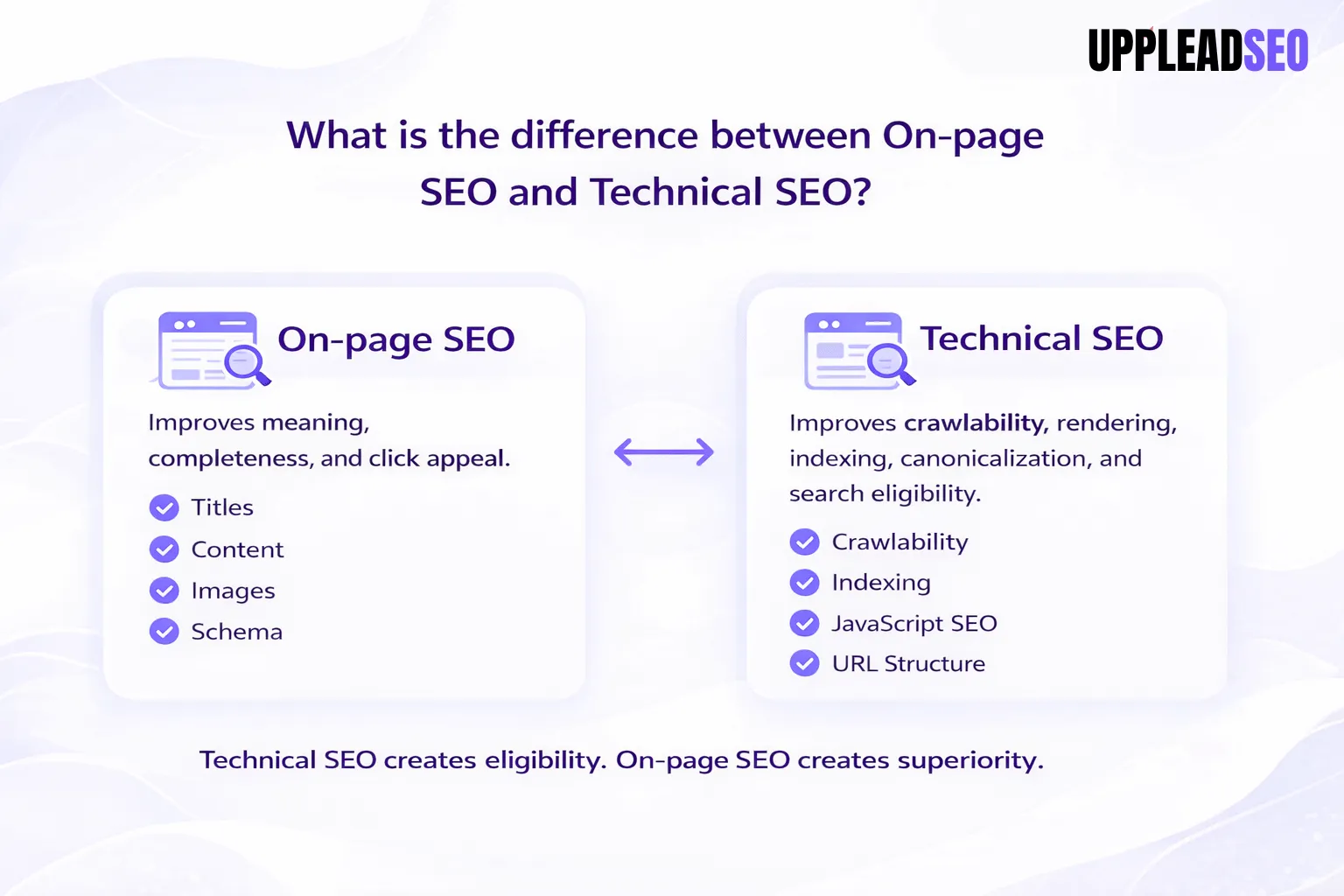
A page can fail with excellent on-page work if the page is non-indexable, duplicated, JS-hidden, or canonically misassigned. A page can also fail with strong technical foundations if the content is generic, weak, or unhelpful. The best SEO work happens when technical SEO creates eligibility and on-page SEO creates superiority.
How do you do On-page SEO for specific industries?
Industry on-page SEO works when the page template matches the buyer’s decision model and trust threshold. Health pages need higher trust signals. Local service pages need business details. Product pages need buying attributes and variant clarity. Google’s people-first documentation explicitly highlights YMYL topics, and Google’s local business documentation supports machine-readable business details such as hours, phones, addresses, and departments.
How do you do On-page SEO for dentist and medical pages?
Dentist and medical pages work better when the page includes qualified expertise, clear treatment scope, update dates, local business details, and risk-sensitive explanations. Health topics fall inside YMYL contexts in Google’s people-first guidance, and local business structured data can expose location, phone, hours, and departments.
A strong medical or dental page usually includes 8 items: service definition, symptoms or use case, who the service is for, who the service is not for, clinician or reviewer identity, address and phone, opening hours, and next-step action. Generic “best dentist” pages usually lose because generic pages do not resolve safety and trust questions.
How do you do On-page SEO for automotive pages?
Automotive pages work better when the page states the exact vehicle, service, fitment, part identity, and decision details. Google’s merchant-listing guidance supports product-specific structured data and variant-specific URLs, and Google explicitly notes that Car is not automatically treated as a Product subtype for some search features unless both types are included.
For automotive service pages, include make, model, year, trim, engine, service scope, warning signs, labor context, and local availability. For automotive ecommerce pages, include SKU, MPN, compatibility, shipping, returns, warranty, and a clear product-variant model. Automotive SEO loses fast when the page hides fitment logic.
How do you do On-page SEO on ecommerce platforms?
Ecommerce on-page SEO succeeds when product pages, collection pages, and category pages each do one job clearly. Google’s ecommerce documentation focuses on crawlable site navigation, direct HTML links, distinct variant URLs, canonical consistency, and product markup.
How do you do On-page SEO on Shopify?
Shopify covers several structural basics automatically, but Shopify still requires human work on titles, descriptions, menus, internal anchors, image names, and alt text. Shopify says logical hierarchy and simple readable URLs are built in, recommends descriptive file names for images and descriptive internal-link text, recommends concise alt text with 125 characters or fewer, and warns that search previews may cut off around 70 characters for titles and 160 for descriptions. Shopify also suggests square product images around 2048 by 2048 pixels and limits product or collection images to under 20 MB.
The practical Shopify rule is simple: let Shopify handle the base architecture, then improve collection copy, product-attribute depth, internal-link text, image alt text, and search-listing previews by hand. Built-in SEO does not replace page-level editorial decisions.
How do you do On-page SEO on Etsy?
Etsy titles matter, but Etsy’s own 2025 guidance says the title does not need to do all the work anymore. Etsy says the search system now takes a more holistic view of the listing, including title, tags, attributes, descriptions, first photo, and reviews. Etsy recommends clearly stating the item, placing the most important descriptors first, avoiding repeated words, and often keeping the title under 15 words for scannability. Etsy also says attributes are essential because attributes power category-specific filters and are the only way to appear in filtered results when that attribute is required.
That means Etsy on-page SEO is no longer “stuff the title.” Etsy on-page SEO is listing clarity. Put the noun first. Put objective descriptors next. Move subjective sales words out. Fill relevant attributes. Use the first image like a conversion surface, not just a decoration surface.
How do you do On-page SEO on other ecommerce platforms?
The same Google rules still apply on WooCommerce, BigCommerce, Magento, headless builds, and custom stacks. Other ecommerce platforms still need direct crawl paths, stable variant URLs, canonical consistency, and product data in the initial HTML where possible. Google recommends direct <a href> links, consistent URLs across links, canonicals, and sitemaps, unique URLs for meaningful variants, and product markup on single-product pages.
Do On-page SEO factors need updating?
On-page SEO factors need updating whenever facts change, intent shifts, templates drift, or evidence expires. Google’s starter guide explicitly recommends keeping content up to date and updating or deleting content that is no longer relevant. Google also notes that title-source changes can take days to weeks to be reprocessed, and recrawling changes may take from days to months depending on the page and system.
Update a page when any of these 7 triggers appear:
- Change outdated statistics, screenshots, or prices.
- Refresh weak title and snippet packaging.
- Fix invalid schema or broken canonicals.
- Improve internal links to the main quality node.
- Compress media that hurts LCP.
- Expand missing questions that now appear in Search Console.
- Reframe the page when SERP intent clearly changed.
A strong page is not published once. A strong page is maintained.
Thinking of a career in Off-page SEO?
Off-page SEO is a different specialization, but off-page SEO is easier to learn after mastering on-page structure, intent matching, and evidence writing. On-page roles focus on page architecture, content systems, snippets, schema, internal links, and UX. Off-page roles focus on PR, link earning, citation building, reviews, partnerships, and reputation signals within spam-safe boundaries.
A strong SEO career path usually starts with on-page SEO because on-page SEO teaches search intent, information architecture, content packaging, and measurement discipline. Off-page SEO adds external trust and distribution after the page itself deserves attention.
Does On-page SEO still matter when AI drives search algorithms?
On-page SEO still matters because AI-driven search experiences still rely on indexability, snippet eligibility, text clarity, internal links, page experience, and matching structured data. Google explicitly says classic SEO best practices remain relevant for AI Overviews and AI Mode and that no special AI schema or AI file is required.
That means AI did not kill on-page SEO. AI raised the bar for on-page SEO. A page now needs to be clearer, more extractable, and better supported with visible text, images, and structure. AI systems can broaden discovery, but AI systems still depend on the underlying page signals that Search can crawl, index, interpret, and trust.
Does a traditional On-page SEO checklist give rankings?
A traditional checklist does not give rankings. A traditional checklist gives completeness, error control, and baseline eligibility. Google says there are no secrets that automatically rank a site first, Google ranking uses many signals and systems, there is no single page-experience signal, and correct structured data does not guarantee rich-result visibility. Yes no green light of yoast seo give you rankings these are just marketing companies who sell their churan(product) to peoples.
That is the dark truth behind almost every old checklist. A checklist can fix a broken page. A checklist can make a weak page eligible. A checklist cannot make an average page better than a stronger competitor with better proof, better entity coverage, better internal support, and better task completion.
Mini on-page SEO audit checklist
Use this audit template as a control sheet, not as a ranking promise.
| Audit field | Sample finding | Priority |
|---|---|---|
| Intent match | answers definition but misses comparison intent | High |
| Title link | title is generic and too broad | High |
| Meta description | duplicated across 18 pages | Medium |
| Heading structure | H2 blocks exist, but no direct answer under headings | High |
| Content proof | no named studies, dates, or organizational evidence | High |
| Internal links | only 3 in-links from weak pages | High |
| Schema | Article valid, Organization missing | Medium |
| CWV | LCP 3.1s, INP 210ms, CLS 0.03 | High |
| Image system | generic filenames, weak alt text | Medium |
| Update cycle | no refresh in 14 months | High |
That checklist becomes useful only after the page also wins the harder questions: Is the page the best answer? Is the evidence named? Is the structure extractable? Is the page supported by the site graph?
How do tools help in On-page SEO?
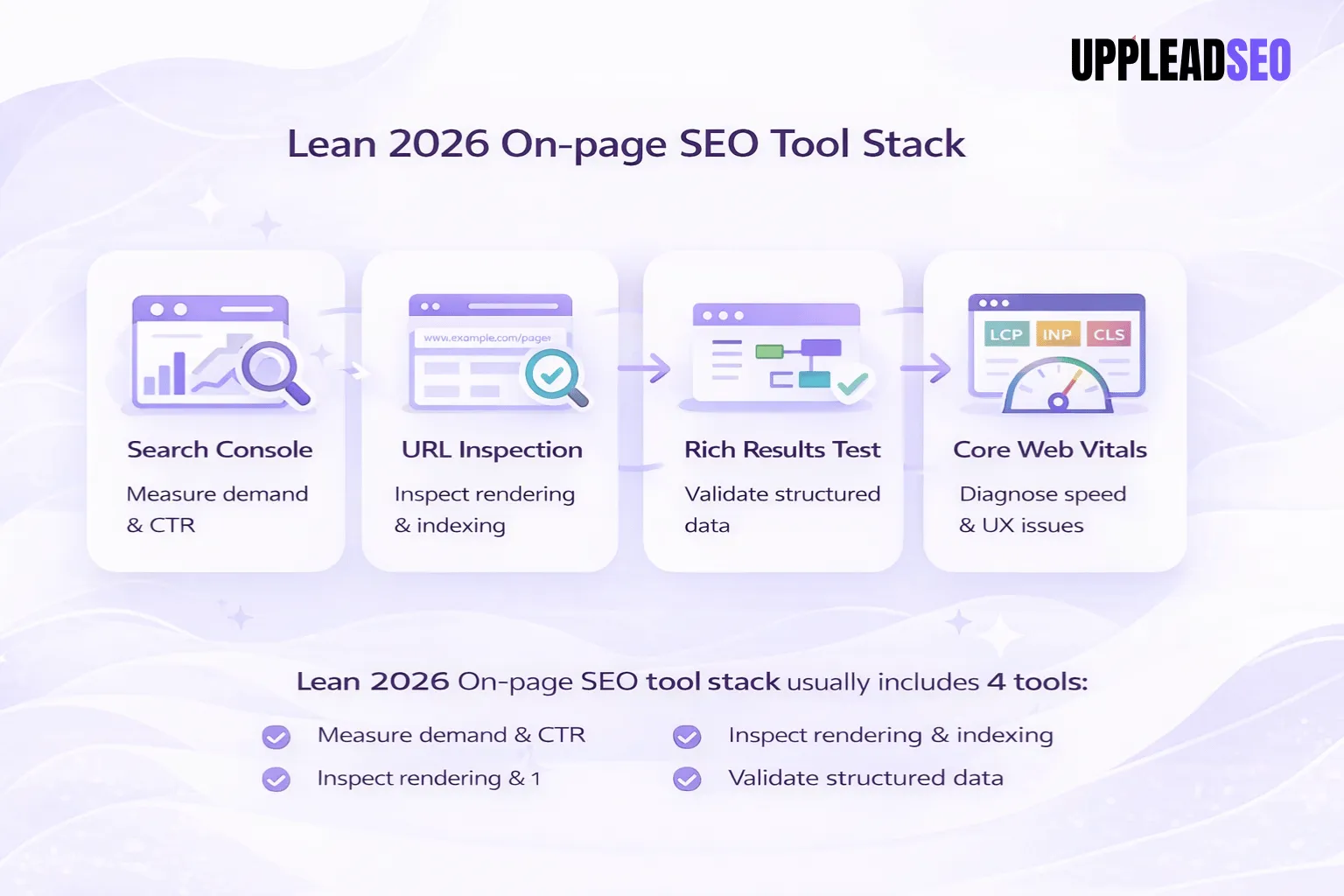
Tools help by reducing blind spots, validating implementations, and measuring change. Search Console Performance reports show queries, pages, clicks, impressions, and CTR. URL Inspection shows indexability, canonical selection, structured-data visibility, and rendered output. Rich Results Test checks what Google rich results can be generated from structured data. Core Web Vitals and PageSpeed-style performance tools expose load, interaction, and layout problems.
A lean 2026 on-page SEO tool stack usually includes 4 tools:
- Measure search demand and CTR with Search Console.
- Inspect rendering and indexing with URL Inspection.
- Validate markup with Rich Results Test.
- Diagnose speed and interaction issues with Core Web Vitals data.
Platforms add their own layer. Shopify adds search-listing previews and media management. Etsy adds the search-visibility dashboard and listing guidance tools. The winning pattern stays the same: use tools for validation, not for writing the strategy.
Where can you get professional On-page SEO help?
Professional on-page SEO help is useful when a site has template debt, content debt, or measurement debt. The highest-value engagement usually starts with a page inventory, intent map, title and snippet rewrite plan, internal-link graph, schema validation pass, image workflow, and refresh calendar.
How much does On-page SEO help cost?
On-page SEO pricing is usually custom-scoped by page count, CMS complexity, template count, schema scope, image workload, and revision rounds. A 20-page local service site, a 500-page editorial site, and a 25,000-product ecommerce store do not have the same labor profile.
What can UppLeadSEO include?
UppLeadSEO can position the offer around 6 deliverables:
- Audit page-level SEO issues and content gaps.
- Rewrite titles, snippets, headings, and intro answers.
- Map internal links around quality nodes and money pages.
- Validate schema for article, organization, local business, product, and video pages.
- Optimize media, alt text, filenames, and compression workflows.
- Maintain refresh cycles for facts, templates, and declining pages.
The strongest CTA is not “we do SEO.” The strongest CTA is “we repair page clarity, page structure, and page competitiveness.”