


 Muhammad Saad

 Summarize in ChatGPT
Local SEO in 2026 still runs on three pillars: relevance, distance, and prominence. What works is a complete Google Business Profile, exact categories, accurate hours, recent reviews, local links and mentions, and location pages that explain the service clearly. What does not work is fake reviews, title-tag gimmicks, schema treated as a direct local ranking shortcut, or checklist-only SEO with no local proof. Google’s official local guidance and its 2026 Business Profile playbook still point to accuracy, completeness, reviews, links, photos, and profile freshness.
Google reported that in 2024 it helped drive more than 2 billion direct connections each month for more than 19 million American businesses, while detailed or complete profiles drove materially higher consideration, views, and clicks. SOCi reports that 80% of U.S. consumers search for local businesses weekly and 32% do so daily. Local SEO is therefore not a side channel. Local SEO is a buying channel.
I summrize it in table What works and what does not work in Local SEO.
The table below separates strong local SEO gains from tactics that create activity without creating strong local visibility.
| Proven lever | Weak or risky lever | Why the difference matters |
|---|---|---|
| Complete Google Business Profile | Incomplete or outdated profile | Google says complete and accurate profiles are more likely to show in local results |
| Real reviews plus real replies | Fake, bought, or sentiment-incentivized reviews | Reviews support prominence and trust; fake reviews create policy and legal risk |
| Exact categories, services, hours, attributes | Vague profile setup | Categories and detailed fields help Google match the business to relevant searches |
| Service + location landing pages | Thin city-page spam | Page-level clarity supports organic visibility and AI understanding |
| Accurate citations plus local mentions | Mass low-quality directory spam | Accuracy and relevance confirm the entity better than bulk noise |
| Local links and PR mentions | Generic national link profile only | Google’s local prominence includes website links and reputation signals |
| Crawlable, indexable, text-rich pages | Custom code alone | No “custom website” ranking factor exists without technical and content quality |
| AI-assisted workflows with human review | AI-generated fake proof | Google still requires visible text, indexed pages, and accurate profile data |
What is Local SEO?
Local SEO is visibility management for a real business entity, real service area, and real website inside Google Search and Google Maps. Google says local results are mainly based on relevance, distance, and prominence, while Google Search ranking systems still evaluate web pages at page level using many signals. Local SEO therefore is not only map optimization. Local SEO is profile optimization plus website optimization plus reputation proof.
Why is Local SEO important?
Local SEO matters because customers compare local businesses on Google before visiting, calling, booking, or buying. BrightLocal reports that the top three most trusted platforms for researching local businesses are Google at 66%, Google Maps at 45%, and the business’s own website at 36%. Backlinko found that 42% of local searchers click a Google Maps Pack result.
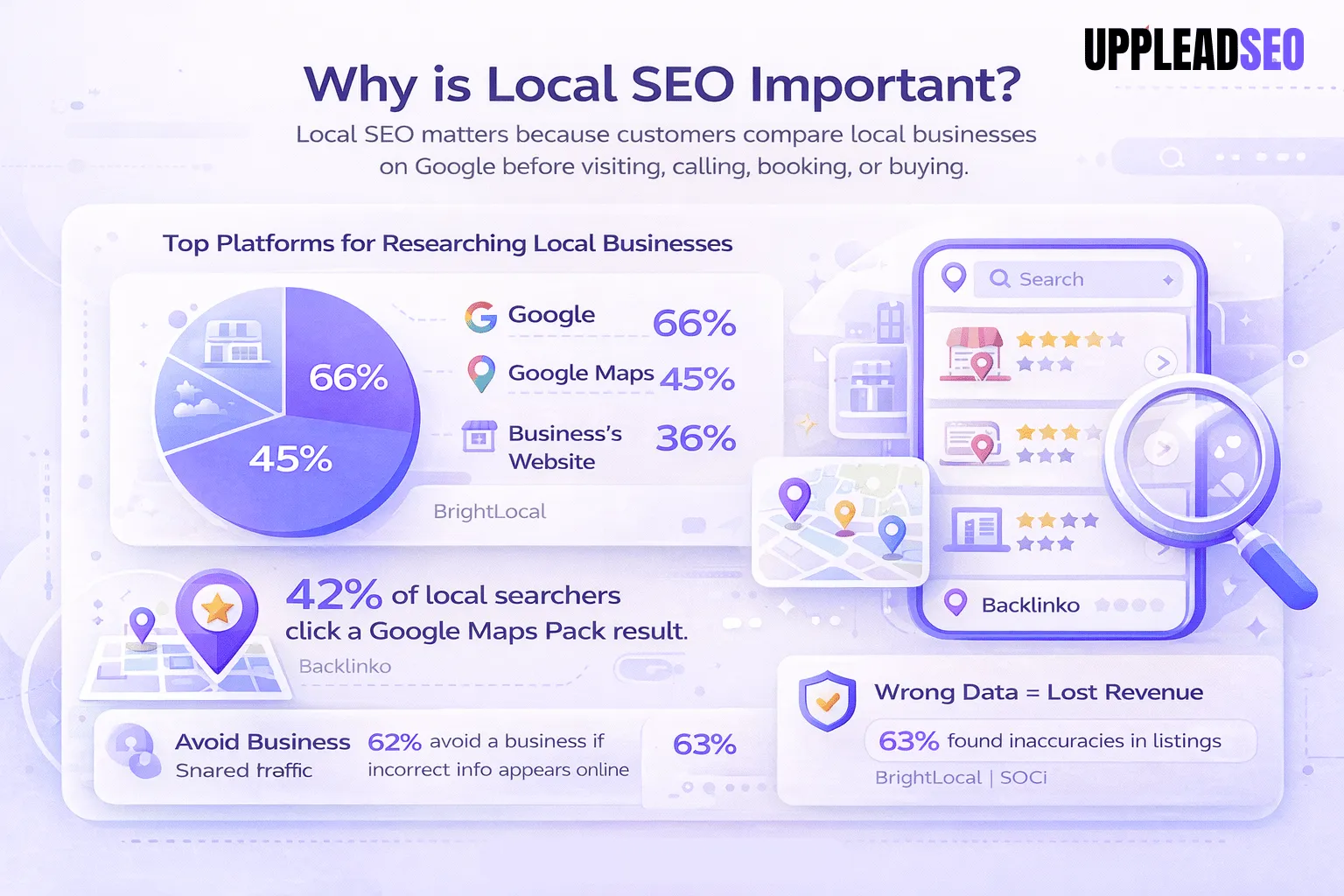
Local SEO also protects trust. BrightLocal reports that 62% of consumers avoid a business if incorrect information appears online, while SOCi found 63% of consumers have encountered inaccuracies in major business listings. In Local SEO, wrong data is not a small error. Wrong data is lost revenue.
How do local search results work?
Local search works by matching the searcher’s intent to the business’s relevance, distance, and prominence. Google defines relevance as how well the profile matches the query, distance as proximity to the searcher, and prominence as how well-known the business is, including signals such as reviews and website links. That model explains why Local SEO is part entity management, part content strategy, and part authority building.
The table below separates the three main local search surfaces and the asset that most strongly controls each one.
| Search surface | Main ranking logic | Main asset | Main measurement |
|---|---|---|---|
| Map Pack / Maps | Relevance, distance, prominence | Google Business Profile | Calls, directions, website clicks, profile views |
| Local organic results | Page-level ranking systems | Local landing pages | Impressions, clicks, CTR, average position |
| AI local answers | Same SEO fundamentals plus indexed, text-rich, accurate pages | Helpful pages + updated profile + matching structured data | Search Console web traffic + conversions |
Google documents the map layer through relevance, distance, and prominence, documents page-level Search ranking separately, and says AI features use the same SEO fundamentals without extra technical requirements.
How do you do Local SEO in 2026?
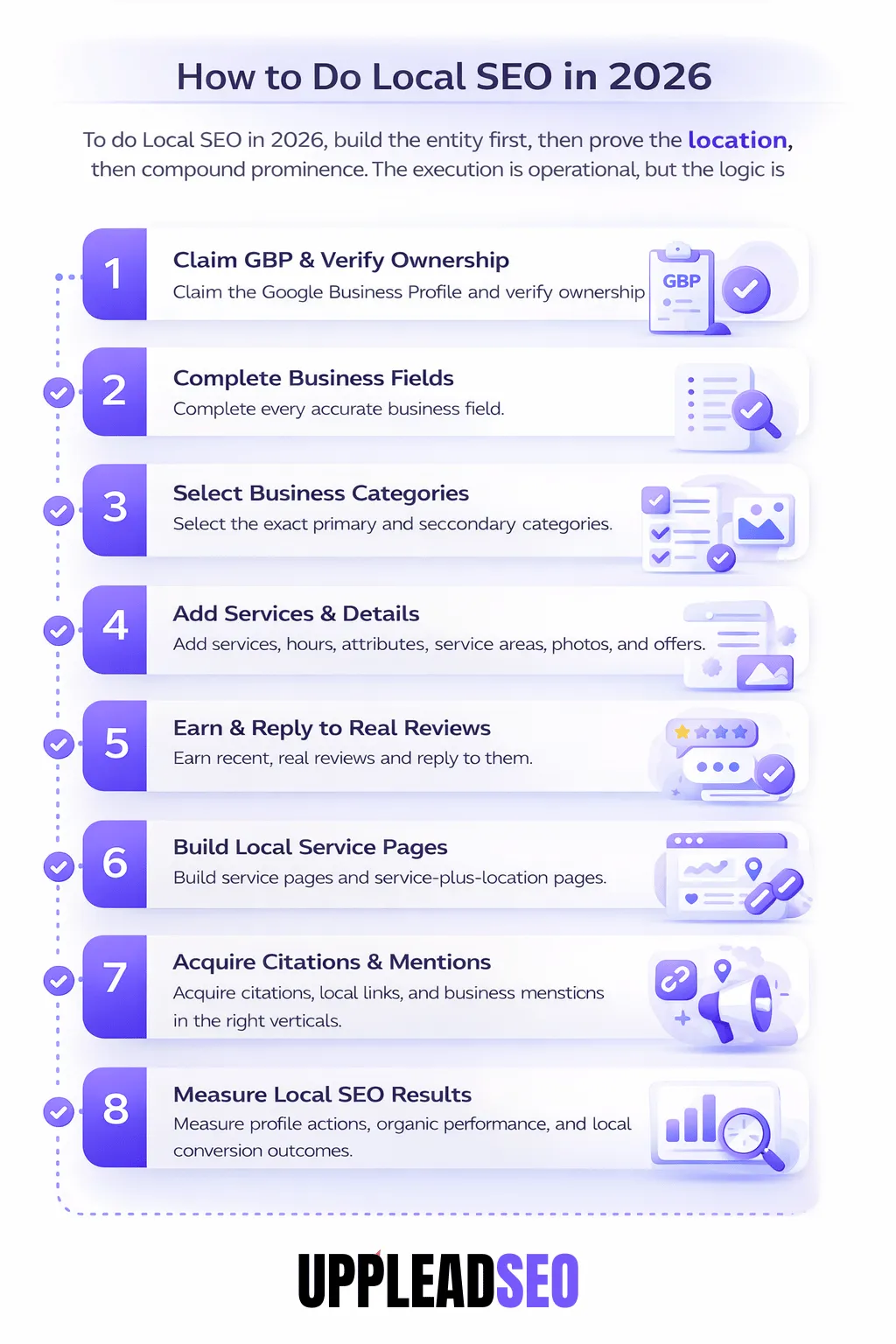
To do Local SEO in 2026, build the entity first, then prove the location, then compound prominence. The execution is operational, but the logic is linear.
- Claim the Google Business Profile and verify ownership.
- Complete every accurate business field.
- Select the exact primary and secondary categories.
- Add services, hours, attributes, service areas, photos, and offers.
- Earn recent, real reviews and reply to them.
- Build service pages and service-plus-location pages.
- Acquire citations, local links, and business mentions in the right verticals.
- Measure profile actions, organic performance, and local conversion outcomes.
Those steps mirror Google’s local ranking guidance, Google’s 2026 GBP playbook, and Google’s Search documentation for indexing, page clarity, and performance analysis.
What works in Google Business Profile?
Google Business Profile is the highest-leverage local asset because Google uses profile completeness, categories, reviews, photos, and accuracy to match local intent. Google’s official 2026 playbook is explicit that a detailed, complete, and regularly updated profile produces stronger visibility and actions.
The table below lists the Business Profile fields that create the biggest visibility and action gains in Google’s 2026 playbook.
| Profile field | Why it works | Proof snapshot |
|---|---|---|
| Business category | Defines the core service and product set | Google calls categories direct signals and allows up to 10 categories |
| Hours | Removes visit friction | 96% are more likely to visit a business that displays hours |
| Service area | Clarifies operational boundaries | Up to 20 service areas; keep the boundary specific |
| Attributes | Increases discoverability for feature-based searches | Attributes such as Wi‑Fi, pet-friendly, or outdoor seating display directly in Search and Maps |
| Offerings / services / menus | Clarifies what the business actually sells | 1 in 3 customers checks offerings before visiting |
| Photos / videos | Improves click, direction, and visit intent | 42% more direction requests, 35% more website clicks, 90% more likely to visit |
| Posts / offers | Adds freshness and merchandising | 50% of customers look for promotions or discounts when searching online |
| Reviews / replies | Increases prominence and buyer confidence | Google says more reviews and positive ratings can help local ranking |
These field-level data points come from Google’s Official GBP Best Practices Playbook 2026 and Google’s Business Profile Help documentation.
Completeness is not a cosmetic task. Completeness is a visibility task. Google states that businesses with complete and accurate information are more likely to show in local search results, while the 2026 playbook says regularly updated profiles receive 5x more views and complete profiles receive 7x more clicks.
What works in Google Maps and the Map Pack?
The Map Pack matters because it compresses local choice into a small set of visible profiles. Backlinko’s user behavior study found that 42% of local searchers clicked a Google Maps Pack result. Google Business Profile performance then records map-driven actions such as directions, calls, views, and website clicks.
Map Pack rankings and organic rankings are not the same. The map pack is shaped mainly by relevance, distance, and prominence. Local organic results are shaped by broader page-level Search systems. A business can therefore rank well in organic results and poorly in the pack, or the reverse.
Do near me queries and local keyword research still matter?
Yes, but local relevance matters more than the literal phrase “near me.” Google says current location is used to give nearby results even if the searcher does not include a location in the query. That means “near me” intent is often implicit. The winning move is not phrase stuffing. The winning move is location alignment.
Local keyword research still matters because relevance begins with the exact language customers use. Google says relevance depends on how well the profile matches the query, and Search Console shows the actual queries already generating impressions, clicks, CTR, and position. Research the five major local groups: service + city, service + neighborhood, best + service + city, problem + service + location, and brand + review terms.
What do reviews and fake reviews change?
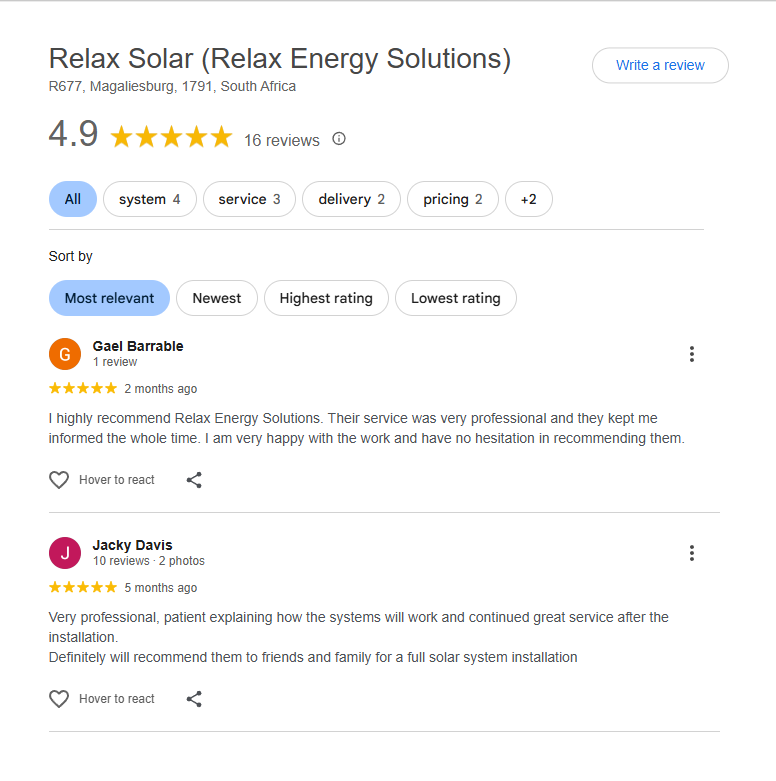
Reviews affect both ranking and conversion. Google states that more reviews and positive ratings can help local ranking. BrightLocal’s 2026 Local Consumer Review Survey found that 97% of consumers read reviews for local businesses and 41% always read reviews when browsing for businesses, up from 29% a year earlier. BrightLocal also found that slow or generic review replies are increasingly seen as a red flag.
Fake reviews are a trust risk and a compliance risk, not a growth tactic. Google says fake or incentivized engagement can trigger restrictions under its fake engagement policy. The FTC says the Consumer Reviews and Testimonials Rule took effect on October 21, 2024 and authorizes civil penalties for knowing violations involving deceptive reviews. BrightLocal’s 2026 research found 97% of consumers think fake reviews should have consequences, 37% support financial penalties, and 16% favor criminal consequences.
What does the history of Local SEO still teach?
Local SEO moved from citation-heavy setup work to full entity-based proof across profile, website, reviews, and links. The 2017 Local Search Ranking Factors survey, based on opinions from almost 40 local search experts, emphasized proximity, citations, links, and Google reviews. Google’s official documentation now simplifies the same competition into relevance, distance, and prominence.
What did Pigeon change?
Pigeon tied local visibility more closely to traditional web ranking signals. That update mattered because it reduced the gap between “local SEO” and “regular SEO.”
What did Possum change?
Possum increased local filter volatility and proximity sensitivity. One study cited by BrightLocal and Sterling Sky reported changes across 64% of local results after Possum.
What did Hawk change?
Hawk softened part of Possum’s aggressive proximity filtering. The practical lesson remained the same: local rankings are highly location-sensitive and never fully static.
Do citations still matter?
Yes, citations still matter, but citation accuracy and relevance matter more than raw citation volume. Whitespark says Google frequently uses business listing sources to confirm business information. BrightLocal’s citation study found that top-10 local businesses averaged 81 citations, position #1 averaged 86, and position #10 averaged 75, but the same study warns that correlation does not prove causation.
What are NAP citations?
A NAP citation is a published reference to a business name, address, and phone number on a listing source. Structured citations live on directories and business information platforms that Google can use to confirm the business entity.
What types of local listings matter most?
The listing types that matter most are core platforms, industry directories, and high-trust local information sources. BrightLocal’s 2024 visibility study found that directories made up 31% of local-intent organic results overall and 37% of informational local-intent results. That study surfaced strong vertical examples such as Healthgrades, Zocdoc, Thumbtack, BBB, Booksy, DoorDash, and Gymbird.
How do you get and monitor local citations?
Audit core listings first, correct duplicates second, and add the directories already visible in the vertical third. Use a simple operating sequence: audit, fix, add, monitor. That sequence protects NAP consistency and keeps the business entity stable across Google’s ecosystem.
- Audit the business on core platforms and main industry sites.
- Fix duplicate or incorrect NAP variants.
- Add listings on the directories that already rank for the vertical.
- Monitor drift, new duplicates, and suppressed listings each month.
What makes a citation high quality?
A high-quality citation is accurate, relevant, indexed, and trusted enough to influence discovery or data confirmation. BrightLocal reports that 62% of consumers avoid a business if incorrect information appears online, while 23% encounter fake business listings at least monthly. Citation quality therefore is not only an SEO matter. Citation quality is a trust matter.
Are external links still important?
Yes, external links remain a local ranking lever because Google’s definition of prominence includes website links. Google states that prominent places are more likely to show in local results and that prominence is based partly on how many websites link to the business and how many reviews the business has. The 2017 Moz/Whitespark guide also elevated link diversity and link quantity as local pack factors.
How do you find citation and link opportunities?
Find opportunities where local intent already produces directories, mentions, or local publications in the SERP. BrightLocal’s 2024 visibility study shows strong local-intent representation from Yelp, Tripadvisor, Expertise, BBB, Thumbtack, Healthgrades, Zocdoc, Booksy, and similar vertical platforms. The same study highlights opportunity in local publications, interviews, expert contributions, and city “best of” mentions.
What additional Local SEO practices still work?
Local PR, local partnerships, chamber participation, and local sponsorships still work because they create local mentions, local links, and local reputation signals. In practice, that means chamber listings, event sponsor pages, partner-business pages, local nonprofit pages, school sponsorship pages, and local media features. Those assets feed the same prominence logic Google documents in local ranking.
How do Local SEO and semantic SEO work together?
Local SEO with semantic SEO connects one business entity, one service entity, and one location entity across every surface Google can read. Google says structured data helps Search understand page meaning, while Google’s AI feature documentation says important content should be available in text, structured data should match visible text, and Business Profile data should stay current. Strong local pages therefore repeat the same entity pattern across title, H1, intro, services, proof, schema, and profile fields.
A business topic page and a location topic page work best when both contexts intersect clearly. A generic service page explains the service. A service-plus-location page explains the service in the exact market, with local proof, local examples, local service boundaries, and local conversion intent. That creates a tighter context vector for both organic Search and local Search.
Is on-page SEO important for Local SEO?
Yes, on-page SEO is essential because local organic rankings and AI citations come from pages, not from the Business Profile alone. Google’s title link documentation recommends descriptive, concise titles and warns against keyword stuffing and boilerplate. Google’s AI documentation also says important content should be textual and structured data should match the visible page text.
Use the core service and location above the fold. Place the service and place in the title, H1, first paragraph, and primary conversion area. Google says title links can be built from the title element, the visible page title, headings, and other prominent text, so clear first-screen labeling improves both user comprehension and machine comprehension.
Use a Google Map embed for user orientation, not as a magic ranking lever. Google’s documented local ranking framework still centers on relevance, distance, and prominence. A map embed can help a user confirm the place visually, but a map embed is not documented as a core local ranking signal.
What is the difference between Local SEO, on-page SEO, and technical SEO?
The difference is simple: Local SEO proves local relevance, on-page SEO explains page meaning, and technical SEO makes the page eligible to be crawled and indexed.
| Discipline | Main job | Main assets | Main failure mode |
|---|---|---|---|
| Local SEO | Prove local relevance and prominence | GBP, reviews, citations, local links, local pages | Weak map pack visibility or wrong geography |
| On-page SEO | Explain topic and intent on the page | Titles, H1, intro, service copy, internal links, schema | Low clarity, low CTR, weak topical match |
| Technical SEO | Make the page crawlable and indexable | Robots, HTTP 200, indexable text, canonicals, renderability | Page not indexed or not processed correctly |
Google documents local ranking separately from page-level ranking systems, and also documents the minimum technical requirements for Google Search eligibility.
No discipline replaces the others. Local SEO without technical SEO loses eligibility. Technical SEO without local relevance loses local intent. On-page SEO without prominence often loses the pack. The three systems compound, not substitute.
What local tactics do not work in 2026?
The most common Local SEO failures in 2026 come from overvaluing shortcuts and undervaluing entity proof. The most repeated mistakes are fake reviews, title-tag theatrics, city-page spam, outdated profile fields, and treating schema as a direct local ranking button.
Schema is not the documented direct local ranking shortcut many people claim. Google says structured data helps Search understand page meaning and enable richer search appearances. Google’s local ranking documentation names relevance, distance, and prominence as the main local factors. Schema helps understanding and appearance. Schema does not replace local proof.
Title-tag cliffhangers are weaker than descriptive titles. Google recommends concise, descriptive titles and warns against keyword stuffing, boilerplate, and half-empty titles. Local pages win more reliably when the title states the service and place directly.
Checklist-only SEO does not guarantee rankings. Accurate setup creates eligibility, but prominence, distance, reviews, and local links still separate winners from near-winners. That is why two businesses with similar profile completion can produce very different local outcomes.
How can AI help you do Local SEO?
AI helps with speed, not with truth. Use AI to think and create strategy by yourself, draft location page briefs, summarize review themes, identify citation gaps, and speed up reporting. Do not use AI to fabricate reviews, fabricate addresses, or mass-produce thin city pages. Google’s own Business Profile AI description feature requires manual review for accuracy.
What local SEO optimization helps AI answers?
Same Local seo optimization that helps Search also helps AI answers. Google says there are no additional technical requirements for AI features and no special schema.org structured data required. Pages still need to be indexed, eligible for snippets, rich in visible text, supported by good internal links, and aligned with up-to-date Business Profile and Merchant Center data.
Local AI answers reward clean business facts and strong page clarity. Google’s AI features documentation says important content should be in text form, structured data should match visible text, and profile data should stay updated. In local search, that means clear service definitions, accurate hours, accurate address or service area data, current reviews, and pages that answer place-specific service intent directly.
Are ranking factors different for custom websites?
No special local ranking factor exists for a “custom website.” A custom build helps only when it improves the basics Google documents: crawl access, HTTP 200 responses, indexable text, clear titles, internal linking, and structured data that matches visible content. Google’s technical requirements remain the minimum gate, and Search still ranks individual pages, not development stacks.
How do you do Local SEO for specific industries?
Local SEO changes by industry because Google’s local organic results surface different directories, different trust signals, and different profile features by vertical.
| Industry | What to emphasize | Strong directory / SERP pattern |
|---|---|---|
| Home services | Service area, review freshness, emergency pages, before/after media | BBB, Angi, Thumbtack, Expertise |
| Healthcare | Practitioner accuracy, credentials, appointment flows, reputation | Healthgrades, Zocdoc, WebMD |
| Legal | Practice area + city pages, local trust proof, reviews, local mentions | Avvo, Justia, Super Lawyers |
| Restaurants | Menus, hours, photos, offers, reservations | Tripadvisor, delivery platforms, Yelp |
| Beauty / fitness | Services, pricing, images, bookings | Booksy, ClassPass, Yelp |
| Hospitality | Photos, amenities, offers, review management | Tripadvisor, Expedia, Booking.com |
BrightLocal’s 2024 visibility study found strong vertical differences in the directories that appear across industries such as dentists, chiropractors, electricians, salons, hotels, and tax advisors. Industry fit therefore beats generic directory spraying.
How do you do Local SEO on ecommerce platforms?
Local SEO on ecommerce platforms works when the retailer has physical stores, pickup options, or store-level inventory. Google’s Merchant Center documentation says local inventory ads and free local listings let retailers show nearby shoppers product and store information. Google also reports that retailers using local inventory ads in addition to Shopping ads saw a 21% increase in store visits and a 9% increase in online conversions for products available in store.
The best local ecommerce setup is store pages plus Business Profile plus Merchant Center. Google says stores can be connected from Business Profiles to Merchant Center, and real-time local availability can be displayed to nearby searchers. Product pages that show in-store availability, pickup timing, and store-level pricing create stronger local retail intent matching.
How do you monitor Local SEO results and how do tools help?
Track Local SEO in three layers: profile interactions, website search performance, and market coverage. Google Business Profile Performance reports views, searches, directions, calls, website clicks, messages, bookings, and more. Search Console reports queries, pages, countries, devices, impressions, clicks, CTR, and average position.
The table below shows the minimum reporting stack for Local SEO.
| Reporting layer | Core metrics | Best source |
|---|---|---|
| Profile layer | Views, calls, directions, website clicks, bookings | Google Business Profile Performance |
| Website layer | Queries, landing pages, clicks, CTR, average position | Google Search Console |
| Coverage layer | Rank checks by city, neighborhood, and device context | Local rank tracker / geo-grid style sampling |
| Revenue layer | Leads, calls, form fills, bookings, sales | Analytics and CRM |
Google says results vary by time, place, device, and recent search history, while local ranking itself includes distance. That is why a single manual search does not describe the whole local market. Location-sampled rank checks are more reliable than one-point checks.
Tools help by compressing audits, review monitoring, citation tracking, and localized rank measurement. Tools do not replace the base truth. The base truth still comes from Google’s own data sources: Business Profile Performance and Search Console.
Is Local SEO complicated, and is a traditional checklist enough?
Local SEO is simple in theory and difficult in operations. The theory is only three signals: relevance, distance, prominence. The operational complexity appears when the business has multiple locations, duplicate listings, weak review velocity, weak local pages, or inconsistent business data across the web. BrightLocal’s trust data shows why: incorrect data directly causes customer avoidance.
A checklist gives eligibility, not dominance. Accurate categories, hours, citations, and structured data are foundational. Rankings then separate based on proximity, review strength, link quality, local mentions, and page quality. The 2017 expert survey and Google’s current local documentation both support that conclusion.
Thinking of a career in Local SEO?
A Local SEO role combines search, reputation, listings, reporting, and outreach. The day-to-day work usually includes Google Business Profile management, local page optimization, citation cleanup, review workflows, Search Console analysis, and local PR or link outreach. The discipline is practical because Google’s own local ecosystem spans profiles, pages, reviews, merchant data, and performance reporting.
How do you learn Local SEO fully?
Learn Local SEO fully by mastering Google’s local ecosystem in sequence, not in fragments. Start with local ranking fundamentals, then Business Profile management, then on-page local pages, then citations and reviews, then performance reporting, then industry specialization.
- Study Google’s local ranking model.
- Master Google Business Profile fields and workflows.
- Build service pages and service-plus-location pages.
- Audit citations, reviews, and duplicates.
- Measure Search Console and profile performance.
- Practice on one real local business before scaling to multi-location or service-area brands.
See Also: Local SEO Glossary
When is professional Local SEO help worth it?
Professional help is worth it when the business has multiple locations, duplicate listings, profile suspensions, weak review operations, or highly competitive local SERPs. Those problems combine entity management, technical SEO, content production, citation cleanup, review management, and reporting. Businesses usually need specialist support when internal teams cannot keep business data accurate and current across Google, the website, and the directory ecosystem. The businesses that win Local SEO in 2026 do three things better than rivals: they define the entity clearly, prove the location honestly, and compound prominence with reviews, links, mentions, and useful pages. That model remains durable across Google Search, Google Maps, and AI-supported search experiences.