


 Muhammad Saad

 Summarize in ChatGPT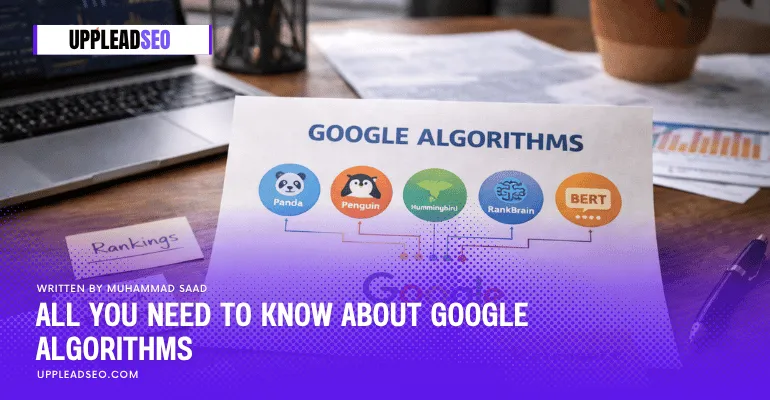
Google algorithms are an evolving stack of automated ranking systems that decide which pages appear, in what order, and for which query intent. Google says Search evaluates many factors and signals across hundreds of billions of pages, and the ranking layer itself runs on hundreds of algorithms and machine learning models rather than one fixed formula. Search then combines crawling, indexing, ranking, freshness, deduplication, and spam control to produce results in fractions of a second.
What are Google algorithms?
Google algorithms are the systems that choose which documents deserve visibility for a specific search. Google describes Search as fully automated and explains that ranking systems work largely at page level, while site-wide signals and classifiers also contribute to how pages are understood and ranked.
Google Search is to see 4 connected layers:
- Discover pages through crawling.
- Understand pages through indexing and content analysis.
- Rank pages through relevance, quality, authority, and intent systems.
- Filter pages through spam, deduplication, diversity, and freshness systems.
What is the difference between a ranking system, an algorithm, and an update?
A ranking system is an ongoing mechanism, while an update is a change rolled out to that mechanism. Google clarified in 2022 that names such as “Helpful Content Update” often refer to updates to an underlying system, not always the permanent name of the system itself. In SEO language, “algorithm” remains the broad umbrella term people use for both systems and updates.
How many Google algorithms are there?
There is no single public fixed count. Google says Search runs on hundreds of algorithms and machine learning models, and its public ranking-systems guide names about 20 notable systems or system groups if historical retired systems are counted. For SEO work, most teams track around 10 major named systems because those explain the biggest historical shifts in ranking behavior.
What are the main types of Google algorithms?
There are 5 families that explain how Google Search behaves in real search results. This is an SEO working model, not Google’s official taxonomy. The 5 families are link analysis, content quality, query understanding, spam and safety, and result-shaping systems such as freshness, passage ranking, site diversity, and deduplication.
What do link analysis systems do?
Link analysis systems use the web’s link graph to estimate importance, authority, and topical relationships. PageRank was the original example, and Google still says link analysis and PageRank continue within core systems, even though modern link evaluation is much more advanced than the 1998 version alone.
What do content quality systems do?
Content quality systems try to rank original, helpful, reliable pages higher than thin, copied, or search-engine-first pages. Panda made this public in 2011, the Helpful Content system expanded it in 2022, and Google’s current documentation says people-first content remains a core ranking goal.
What do query understanding systems do?
Query understanding systems connect words to concepts, syntax, context, and intent instead of matching raw keywords only. Hummingbird, RankBrain, neural matching, BERT, and MUM are the clearest milestones in Google’s move from keyword matching to language and concept understanding.
What do spam and safety systems do?
Spam and safety systems keep manipulative, malicious, and low-value pages out of visible search positions. Penguin targeted link spam, SpamBrain added AI-based spam prevention, and Google says Search remains more than 99% spam free because of continual updates and advanced spam-fighting systems.
What do result-shaping systems do?
Result-shaping systems change which relevant result is shown, how many results from one site appear, how fresh results need to be, and which passage of a page matches best. Google publicly lists freshness, passage ranking, site diversity, and deduplication as notable systems in this layer.
Which major Google algorithms and systems matter most?
The table below maps 10 major systems by public launch year, core job, SEO effect, and current status, using Google’s ranking-systems guide, Google Search Central announcements, Google’s AI-in-Search documentation, and the original Stanford PageRank paper.
| System | First public year | Core job | SEO shift | Status today |
|---|---|---|---|---|
| PageRank | 1998 | Link analysis | Links became authority signals, not just navigation paths | Still part of core systems |
| Panda | 2011 | Content quality | Thin, duplicated, and low-value content lost visibility | Part of core since 2015 |
| Penguin | 2012 | Link spam control | Manipulative link schemes lost value | Integrated into core since 2016 |
| Hummingbird | 2013 | Overall ranking improvement | Whole-query meaning gained weight | Historic milestone folded into ongoing systems |
| RankBrain | 2015 | Concept understanding | Search matched unfamiliar phrases to concepts | Major AI system today |
| Neural Matching | 2018 | Fuzzy concept retrieval | Relevance moved further beyond exact keywords | Active |
| BERT | 2019 | Context and intent | Small words, modifiers, and syntax mattered more | Critical role in almost every English query |
| MUM | 2021 | Multilingual, multimodal understanding | Complex information tasks improved | Used in specific applications, not general ranking |
| Helpful Content | 2022 | People-first content evaluation | Search-engine-first pages weakened | Part of core since March 2024 |
| SpamBrain | 2018–present | AI spam detection | Spam and unnatural links were neutralized at scale | Active |
How did Google algorithms evolve?
Google algorithms evolved through 6 major stages. The broad pattern moved from link-based authority, to large-scale quality filtering, to intent understanding, to deep learning, to multimodal AI, and then to people-first content evaluation plus AI spam control.
- 1998–2010: Link authority era. PageRank and anchor text helped Google outperform simple keyword engines.
- 2011–2012: Quality and anti-spam era. Panda and Penguin attacked low-value content and manipulative links.
- 2013–2015: Intent era. Hummingbird and RankBrain improved whole-query meaning and concept matching.
- 2018–2019: Deep language era. Neural matching and BERT improved retrieval, ranking, and context understanding.
- 2021: Multilingual and multimodal era. MUM expanded cross-language and cross-format understanding.
- 2022–present: People-first and AI enforcement era. Helpful Content and SpamBrain reinforced usefulness, originality, and anti-spam at scale.
How did the major Google algorithms change Search?
What was PageRank?
PageRank was Google’s original citation-based link analysis system. In the 1998 Stanford paper, Larry Page and Sergey Brin described Google as a search engine that made heavy use of hypertext structure, with PageRank using the web’s link graph as a quality ranking signal; the prototype already operated on at least 24 million pages. Google’s current ranking guide also says PageRank still remains part of core ranking systems, although it has evolved substantially.
What did Panda change in 2011?
Panda was Google’s large public quality filter for thin, duplicated, and low-value content. Google’s 2011 rollout note said the initial English launch had a noticeable impact on nearly 12% of queries, and later multilingual expansion affected 6% to 9% of queries in most languages. Google now classifies Panda as a retired named system because it became part of core ranking systems in 2015.
What did Penguin change in 2012?
Penguin was Google’s answer to manipulative link schemes and other webspam tactics. In the 2012 announcement, Google said the change affected about 3.1% of English queries and highlighted tactics such as keyword stuffing and unnatural links; the current ranking guide defines Penguin as a link-spam system that was integrated into core ranking systems in 2016. Google’s newer SpamBrain systems now neutralize unnatural link impact at scale.
What did Hummingbird change in 2013?
Hummingbird was a major overhaul of Google’s overall ranking systems, not a minor patch. Google’s ranking guide dates it to August 2013 and treats it as a major improvement whose effects continued through later systems. In SEO terms, Hummingbird marked a stronger move toward understanding whole-query meaning, synonyms, and intent rather than treating search as pure keyword lookup.
What did RankBrain change in 2015?
RankBrain was Google’s first deep learning system in Search and a bridge from words to concepts. Google says RankBrain launched in 2015, helped Search understand how words relate to real-world concepts, and is used to help rank top results. Google also says RankBrain remains one of the major AI systems powering Search today.
What did Neural Matching add in 2018?
Neural matching was Google’s retrieval engine for fuzzier concept matching at scale. Google says it introduced neural matching in 2018 to understand how queries relate to pages beyond exact keywords, which helped Search retrieve relevant documents from a massive and constantly changing index. For SEO, the implication was clear: concept coverage mattered more than repeating the exact query phrase.
What did BERT change in 2019?
BERT was Google’s large leap in understanding context, syntax, and the meaning carried by small words. Google’s 2019 announcement said BERT helped Search better understand one in 10 U.S. English searches and improved both ranking and featured snippets; by 2021, Google said BERT played a critical role in almost every English query and in both retrieving and ranking relevant documents. This reduced the value of crude keyword repetition and increased the value of natural, precise language.
What did MUM change in 2021?
MUM was Google’s move from language understanding toward broader information understanding. Google says MUM is 1,000 times more powerful than BERT, trained across 75 languages and many tasks, and designed to understand and generate language across modalities. Google also says MUM is not currently used for general ranking; it has been used for specific applications such as improving vaccine-information searches and featured snippet callouts.
What did the Helpful Content system change in 2022?
The Helpful Content system was Google’s explicit people-first content system. Google says it was announced in 2022 to surface original, helpful content written by people for people, not pages made primarily to gain search traffic; in March 2024 it became part of core ranking systems. Google also said its March 2024 quality changes ultimately produced 45% less low-quality, unoriginal content in search results versus the earlier baseline.
What does SpamBrain do from 2018 to the present?
SpamBrain is Google’s AI-based spam prevention system and the modern center of Search spam enforcement. Google says SpamBrain launched in 2018, identified almost six times more spam sites in 2021 than in 2020, and contributed to a 70% reduction in hacked spam and a 75% reduction in auto-generated spam on hosting platforms. Google later used SpamBrain to neutralize unnatural link impact in the December 2022 link spam update.
What are the biggest myths about Google algorithms?
Is E-E-A-T a direct ranking algorithm?
E-E-A-T is not a direct ranking algorithm. Google says the rater guidelines use E-E-A-T to help evaluate the performance of ranking systems, and those guidelines do not directly influence rankings.
Is MUM the main ranking algorithm today?
MUM is not currently a general ranking system. Google says it is used for specific applications, not for general ranking in Search.
Is page experience one single ranking signal?
Page experience is not one single signal. Google says there is no single page-experience signal, and highly relevant content can still rank even when page experience is weaker, although good experience can help when many relevant pages compete.
Is Google still only about keywords and backlinks?
Google is far beyond a keyword-plus-backlink formula. Google says Search runs on hundreds of algorithms and machine learning models, with systems such as RankBrain, neural matching, BERT, freshness, site diversity, reviews, helpful-content evaluation, and spam detection all working together.
Why does this evolution matter for SEO agencies and publishers?
This evolution matters because Google has moved from simple matching toward intent satisfaction, evidence quality, originality, and spam resistance. Over time, Google shifted from link-based authority, to quality filtering, to semantic understanding, to ensemble AI systems that combine relevance, reliability, page experience, freshness, and anti-spam enforcement. For publishers, the durable strategy is to create pages that solve a searcher’s task with original, reliable, easy-to-use information.
What are the quick-answer FAQs about Google algorithms?
What was the first major Google algorithm?
The first major Google algorithm was PageRank, the citation-based link analysis system described in Stanford research in 1998. Google says PageRank still remains part of its core ranking systems in evolved form.
Which Google algorithm targeted low-quality content?
The best-known low-quality-content systems are Panda and the Helpful Content system. Panda attacked thin and low-value content at scale, while the Helpful Content system targeted content created mainly to gain search traffic instead of helping people.
see also about google bot
Which Google algorithm targeted link spam?
The best-known link-spam systems are Penguin and SpamBrain. Penguin began the public push against manipulative links in 2012, and SpamBrain later expanded AI-based link-spam neutralization at scale.
Which Google algorithms improved language understanding?
The biggest language-understanding milestones are Hummingbird, RankBrain, neural matching, BERT, and MUM. Together they moved Search from keyword matching toward concept matching, context understanding, multilingual learning, and multimodal comprehension.
Which Google system focuses on people-first content?
The system most clearly associated with people-first content is the Helpful Content system. Google says it was built to surface original, helpful content written by people for people, and it became part of core ranking systems in March 2024.